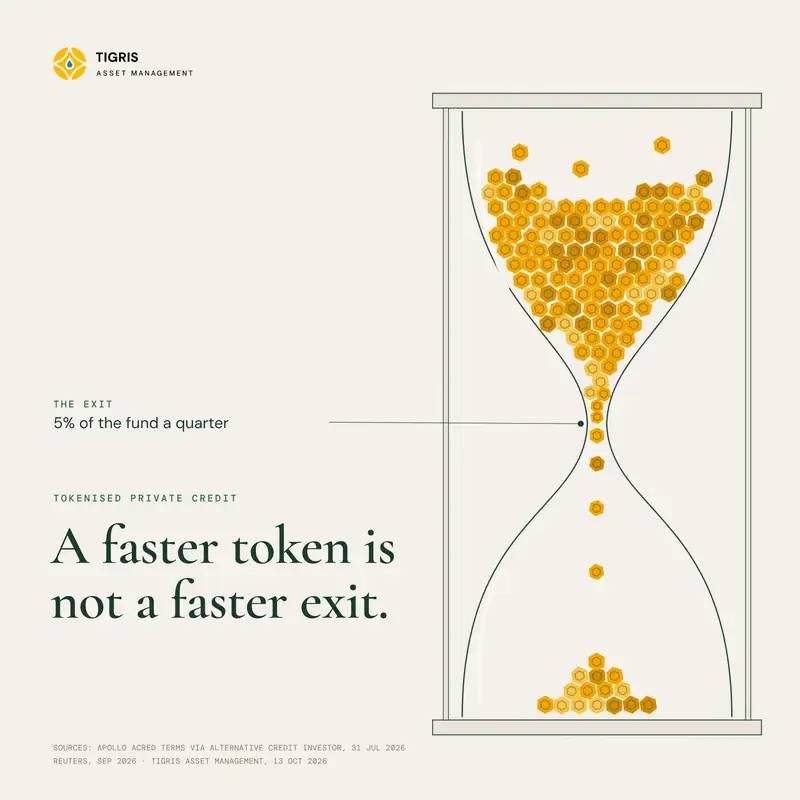
Short answer: no. Tokenisation lets a fund unit change hands in seconds, at any hour. It does not change how fast the loans inside the fund are repaid, or how much a fund lets investors withdraw. Tokenised private credit funds still pay out through quarterly buy-backs, typically capped at 5% of the fund, and in 2026 those caps have been binding.
Data as of 13 October 2026. Facts are sourced and linked. Sections marked “Tigris view” are our interpretation. Forecasts are labelled as forecasts.
Key points
- Wall Street is moving share settlement on-chain. DTCC’s tokenisation service is due to launch in October 2026, and the SEC granted a five-year exemption for tokenised stock trading venues on 17 September 2026.
- Private credit is already tokenised. Apollo’s tokenised credit fund publishes a price every day, yet its cash exit is a quarterly buy-back gated at 5% of the fund.
- The same gate is binding off-chain. In the third quarter of 2026, investors in the largest US non-traded private credit funds asked for about 10% of their money back. The funds met about 47% of those requests.
- The cash to pay investors comes from loan repayments. Direct loans typically run five to seven years, and they repay more slowly when credit conditions worsen.
- When too many investors want out, the strain shows up either as a queue or as a discount. Secondary buyers are already bidding 12.5% to 17.5% below net asset value. Tokenisation can make that price faster and more visible. It cannot make the loans repay sooner.
What is happening: Wall Street’s plumbing is moving on-chain
Barron’s ran a cover story on 9 October 2026 calling tokenisation the biggest change to stock trading in decades. The claim rests on three developments that are now real rather than pilots.
DTCC is switching on tokenised settlement. The Depository Trust & Clearing Corporation, which sits behind settlement of US securities, processed its first live tokenised trades on 15 July 2026 and planned the full launch of its tokenisation service for October 2026. The service issues tokenised versions of securities held at DTC that carry the same entitlements and ownership rights as the traditional securities (DTCC; PostTrade 360). According to Barron’s, trades will at first still execute and settle in the conventional way, and participants can then opt to receive a tokenised version that moves between holders almost instantly, around the clock.
The SEC has opened a door for on-chain trading venues. On 17 September 2026 the SEC issued a conditional five-year “Innovation Exemption” allowing Tokenized Securities Venues to trade tokenised US stocks without registering as exchanges. Only tokens that carry the same rights as the underlying shares qualify, volumes and symbols are limited, and a venue must halt trading whenever the main market halts the stock (Simpson Thacher; FXStreet). Barron’s reports that issuers get 30 calendar days to opt out of having their stock tokenised.
Exchanges are lining up. A joint venture between NYSE owner Intercontinental Exchange and crypto platform OKX filed on 4 October to launch a tokenised market, initially listing 63 companies. One, Cerebras Systems, has already objected. Nasdaq plans its own tokenised equities next year (Barron’s).
The ambitions go further than shares. Firms intend to bring bonds, funds, private equity and real estate on-chain. Forecast: Citigroup’s base case, published in June, has the tokenised asset market growing from US$17bn today to US$5.5tn by 2030 (Barron’s).
What is a tokenised security?
A tokenised security is a digital record of ownership held on a shared ledger, usually a blockchain. Because every participant reads the same ledger, a transfer can settle in seconds instead of passing through brokers, an exchange and a clearing house over a day or more. A tokenised fund unit works the same way: the token is a claim on the fund. The fund’s assets, and the rules for getting cash out of it, are unchanged.
That last sentence is the whole argument of this article.
Why tokenisation matters for listed shares
For listed shares, the benefits are real. Trading could run 24 hours a day, which matters for investors in Asia who today must trade US stocks in US hours. Switching brokers could take minutes rather than days. Banks would need to park less spare collateral across different institutions; Nasdaq estimates the largest firms could earn up to US$340m a year by putting that collateral to work (Barron’s).
There are risks too. Americans for Financial Reform has warned that round-the-clock trading in thin overnight markets could make sudden crashes more likely without circuit breakers (Barron’s). But for a share in a listed company, the asset itself is already liquid. Tokenisation removes friction from something that can be sold.
Private credit is different.
Private credit is already on-chain. Its exit is no faster.
What a tokenised private credit fund actually offers
The best-known example is ACRED, a tokenised feeder fund launched by Apollo and Securitize in January 2025 that invests in Apollo’s Diversified Credit Fund. The fund spans corporate direct lending, asset-backed lending and structured credit.
When Hong Kong exchange HashKey began offering ACRED to professional investors in July 2026, the terms were explicit. Subscriptions can be made daily and a net asset value (NAV) is published daily. Cash, however, comes out only through a quarterly repurchase programme, subject to a 5% fund-level gate. Any part of a request that is not met does not roll over; it has to be submitted again next quarter. Tokens bought through that channel cannot be transferred to other users or withdrawn to an outside wallet (Alternative Credit Investor).
In other words, the token is modern. The exit is the same one every semi-liquid private credit fund already has.
The same gate is binding off-chain in 2026
That exit is under strain. In the first quarter of 2026, US non-traded business development companies (BDCs), the main vehicle for selling private credit to individuals, paid out more in redemptions than they raised for the first time on record: US$6.9bn out against US$4.9bn in (Robert A. Stanger & Co. via AltsWire).
The third quarter was no easier. Across 13 non-traded BDCs that price at NAV, investors asked to redeem US$9.6bn, or 10.1% of NAV. The funds met about 47% of those requests and left US$5.1bn unmet (Stanger, reported by Reuters, 25 September 2026).
| Fund | Q3 2026 redemption requests | Usual quarterly cap |
|---|---|---|
| Blackstone Private Credit Fund (BCRED) | About 10% of shares (US$4.3bn) | 5% |
| HPS Corporate Lending Fund | About 11.5% | 5% |
| Morgan Stanley North Haven Private Income Fund | 11.4% | 5% |
| Ares Strategic Income Fund | 13.1% | 5% |
| Apollo Debt Solutions BDC | 14.7% | 5% |
Sources: Reuters, 3 and 25 September 2026. The 5% cap is the industry standard for these vehicles; individual funds can resize or suspend offers.
BCRED, the largest of them at US$77.2bn, repurchased 5% of its shares in the third quarter after requests of about 10% (Reuters). The fund told regulators that an investor who asked to redeem everything in both the second and third quarters will have received an estimated 75% of the requested capital at NAV (BCRED Form 8-K, 30 September 2026). Two quarterly windows, three quarters of the money.
None of this means these funds are failing. Gates exist so that investors who stay are not hurt by forced sales of loans at poor prices, and BCRED says loan repayments and new inflows continue to exceed its buy-backs. The point is narrower: when many investors want out at once, a quarterly 5% exit is what they get. Putting the fund on a blockchain does not change that rule, because the rule is not about technology.
Where the cash really comes from
A private credit fund can only pay out cash it has. That cash comes from three places: new investors, borrowing, and borrowers repaying their loans. Only the last is under the fund’s control, and it moves slowly.
Direct loans typically run five to seven years and are usually held to maturity (Managed Funds Association). Many are refinanced earlier; Oaktree puts the average lifespan at three to four years (Oaktree). The more important finding is about timing. Using Cliffwater Direct Lending Index data from 2004 to 2017, Stephen Nesbitt found the effective life of US middle market loans averaged 2.75 years but ranged from 2.09 to 7.19 years, and lengthened when market liquidity dried up (Nesbitt, Private Debt, Wiley). Borrowers refinance less when credit is tight.
So the natural source of liquidity slows down at exactly the moment investors ask for it. We examined the same mismatch in Australian private credit, where funds offering monthly liquidity hold development loans that repay only when buildings are finished and sold.
Tigris view: the strain goes into a queue or into a price
When more investors want out than a portfolio can pay, the strain has to land somewhere. It can land in a queue: the fund pays out 5% a quarter at NAV and everyone else waits. Or it can land in a price: investors who will not wait sell to someone else at a discount.
Both are visible today. Non-traded funds have chosen the queue, which is why their reported returns looked steady in the first quarter. Listed BDCs, which trade every day, took the price: the S&P BDC Total Return Index fell 10.1% in the first quarter alone (AltsWire).
And the private secondary market has already put a number on the exit. In September, Cox Capital Partners offered US$20.65 a share for BCRED, 12.5% below its August NAV of US$23.60, and US$20.17 for HPS Corporate Lending Fund, 17.5% below its NAV (BCRED 8-K; Reuters). BCRED’s board told shareholders to reject the offer.
Tokenisation does not remove this choice. What it does is make the price route easier and more visible. If tokenised fund units trade continuously, the discount to NAV becomes a live, public number rather than an occasional private bid. That has three consequences worth thinking about.
1. A visible discount can feed the queue
Marquette Associates has noted that wider discounts on listed BDCs may be contributing to redemptions from non-traded ones, because investors compare the two (Marquette). In our view, a tokenised unit with a 24/7 price next to a monthly or quarterly NAV would make that comparison constant. A falling token price is a reason to join the redemption queue, and a longer queue is a reason for the token price to fall.
2. Collateral loops assume a market that is not there
Tokenised private credit is already being used as collateral. In 2025 Securitize and Gauntlet launched a strategy on the Morpho lending protocol that deposits ACRED, borrows stablecoins against it, buys more ACRED and repeats within set risk limits (Markets Media). In our view, this is where the mismatch matters most. The collateral is valued at a daily NAV but can be turned into cash only quarterly, and only 5% at a time. If a lender ever needs to sell that collateral quickly, the sale price will be set by whoever is willing to buy, not by the NAV.
3. NAV and price will tell different stories
A fund’s NAV is built from valuations of its loans, which for private credit are model-based and updated periodically. A trading price is set by the next seller. The gap between them is information about how the market sees the loans, and it often moves before reported figures do. That is consistent with a theme we return to often: reported fund data lags loan-level reality.
To be fair to the technology: tokenisation can make private credit better to own. Daily NAV publication, faster subscriptions, clean ownership records and a wider pool of potential secondary buyers are all genuine improvements. Over time, deeper secondary markets may narrow the discounts. But a better wrapper does not change what is inside it.
What this means for investors
If you are offered a tokenised private credit or private markets product, the speed of the token is the least important thing about it. Ask these questions instead.
- How does cash come out? How often, how much of the fund can leave each time, how much notice is needed, and what happens if requests exceed the cap.
- What happens to a request that is not filled? Some funds carry it forward. Others, like ACRED through HashKey, require you to submit it again.
- Can the token be sold to another investor, and where? Some tokens cannot leave the platform they were bought on.
- How is NAV calculated, and how often? Compare it with any trading price. A persistent gap is a signal.
- What is inside? Loan maturities, amortisation, first-lien share and borrower quality determine how fast cash actually returns.
- Is the token being used as collateral elsewhere? Leverage built on a gated asset adds a forced seller to the queue.
- Could you live with the exit in a bad quarter? Size the position for the liquidity you would get when everyone wants out, not when nobody does.
For listed shares, tokenisation is likely to be a genuine upgrade. For private assets, treat it as a better wrapper and judge the contents on their own terms. Liquidity belongs to the asset, not the plumbing.
What to watch next
- DTCC’s launch this month, and how many participants take tokenised shares rather than conventional ones.
- Fourth-quarter tender results from the large non-traded credit funds, and whether requests fall back towards the 5% caps.
- Secondary bids for non-traded fund shares. Narrowing discounts would suggest the queue is clearing; widening ones would suggest the opposite.
- SEC rule-making. Barron’s reports that many in the industry expect a formal rule-making process in the coming months. The current exemption runs for five years and could be changed by a future Commission.
- Asia. Tokenised private credit is now sold to professional investors in Hong Kong. In Singapore, MAS has been supporting the commercialisation of tokenisation through Project Guardian, whose industry participants published a Guardian Funds Framework of best practices for tokenised funds in November 2024 (Allen & Gledhill).
Facts, interpretation and forecasts at a glance
| Type | Statement | Basis |
|---|---|---|
| Fact | DTCC planned the full launch of its tokenisation service for October 2026 | DTCC, July 2026 |
| Fact | The SEC granted a five-year exemption for tokenised stock venues on 17 September 2026 | SEC order, law firm summaries |
| Fact | ACRED publishes a daily NAV but redeems quarterly with a 5% fund-level gate (HashKey terms) | Alternative Credit Investor, July 2026 |
| Fact | Large non-traded BDCs met about 47% of Q3 2026 redemption requests | Stanger via Reuters |
| Fact | Secondary offers for BCRED and HPS shares were 12.5% and 17.5% below NAV | BCRED 8-K, Reuters |
| Interpretation | Tokenisation shifts strain from the queue towards a visible price | Tigris view |
| Interpretation | Collateral loops on gated tokens add forced sellers in stress | Tigris view |
| Forecast | Tokenised assets reach US$5.5tn by 2030 | Citigroup base case, via Barron’s |
Frequently asked questions
What is tokenised private credit?
Tokenised private credit is a private credit fund, or a share in one, whose ownership is recorded as a digital token on a blockchain. The token can be issued and transferred quickly, but the fund still holds private loans to companies, and investors still get cash back according to the fund’s redemption terms.
Does tokenisation make private credit liquid?
No. It makes the ownership record faster to transfer. How quickly an investor can turn a private credit holding into cash still depends on the fund’s redemption terms, typically a quarterly buy-back capped at 5% of the fund, and on how fast the underlying loans repay, which is usually over several years.
Why do private credit funds cap redemptions at 5% a quarter?
Private loans cannot be sold quickly without accepting a lower price. A cap stops a rush of withdrawals from forcing the fund to sell loans cheaply, which would hurt the investors who stay. The 5% quarterly limit is the industry standard for non-traded BDCs and similar semi-liquid funds.
What happens when redemption requests exceed the cap?
The fund usually pays out up to the cap and fills each request in proportion. In the third quarter of 2026, large non-traded BDCs met about 47% of requests. Depending on the fund, the unmet part either rolls into the next quarter or must be submitted again.
Can I sell a tokenised fund unit to another investor instead?
Sometimes. Some tokens can be traded on approved venues; others cannot leave the platform they were bought on. Where a sale is possible, the buyer sets the price. In September 2026, secondary offers for shares in two large private credit funds were 12.5% and 17.5% below their NAVs.
Is tokenised private credit riskier than a conventional private credit fund?
The credit risk is the same, because the loans are the same. The added considerations are operational and structural: platform and custody arrangements, transfer restrictions, and whether tokens are being used as collateral for leverage, which can create forced sellers in a downturn.
How is tokenised trading regulated in the US?
On 17 September 2026 the SEC issued a conditional five-year exemption allowing Tokenized Securities Venues to trade tokenised US stocks that carry the same rights as the underlying shares. Anti-fraud rules still apply in full, and venues must halt trading when the main market halts a stock.
Is tokenisation happening in Singapore?
Yes. MAS has run Project Guardian, an industry collaboration on asset tokenisation, since 2022. In November 2024 MAS announced plans to support commercialisation, alongside a Guardian Funds Framework of best practices for tokenised funds developed by industry participants.
Sources
- Barron’s, “The Biggest Change to Stock Trading in Decades Is Coming to Wall Street”, 9 October 2026
- DTCC, “DTCC Turns Tokenization into Reality”, 15 July 2026
- PostTrade 360, DTCC tokenisation service timeline
- Simpson Thacher, SEC Innovation Exemption for Tokenized Securities Venues, 7 October 2026
- FXStreet, SEC five-year exemption, 17 September 2026
- Alternative Credit Investor, HashKey launches tokenised access to Apollo diversified credit fund, 31 July 2026
- Reuters, Blackstone private credit fund maintains 5% cap, 3 September 2026
- Reuters, Secondary buyers offer fund investors liquidity at steep discounts, 25 September 2026
- Blackstone Private Credit Fund, Form 8-K, 30 September 2026
- AltsWire, Non-traded BDC outflows exceed inflows for first time
- Marquette Associates, Liquidity Isn’t Free
- Managed Funds Association, Private Credit Explainer
- Oaktree Capital, Direct Lending: Benefits, Risks and Opportunities
- Stephen L. Nesbitt, Private Debt (Wiley), chapter 6
- Markets Media, Tokenized Apollo credit fund used for levered RWA strategy, May 2025
- Allen & Gledhill, MAS announces plans to support commercialisation of asset tokenisation, November 2024
Related reading
- Australian Private Credit: Monthly Liquidity, Two-Year Buildings
- Private Credit Default Rate: Why It Reads 1%, 6% or 19%
- Why Shares Hit Records While Bitcoin Halved
More Tigris analysis on private credit, liquidity and market structure is on Tigris Insights. To discuss how we approach private credit, arrange a conversation.
This material is for informational purposes only and does not constitute an offer or solicitation to buy or sell any investment product. Past performance is not indicative of future results. Investment products are available only to accredited and institutional investors as defined under the Securities and Futures Act 2001 of Singapore. Tigris Asset Management Pte Ltd holds Capital Markets Services Licence CMS101520 issued by the Monetary Authority of Singapore.
