Last updated 18 September 2026
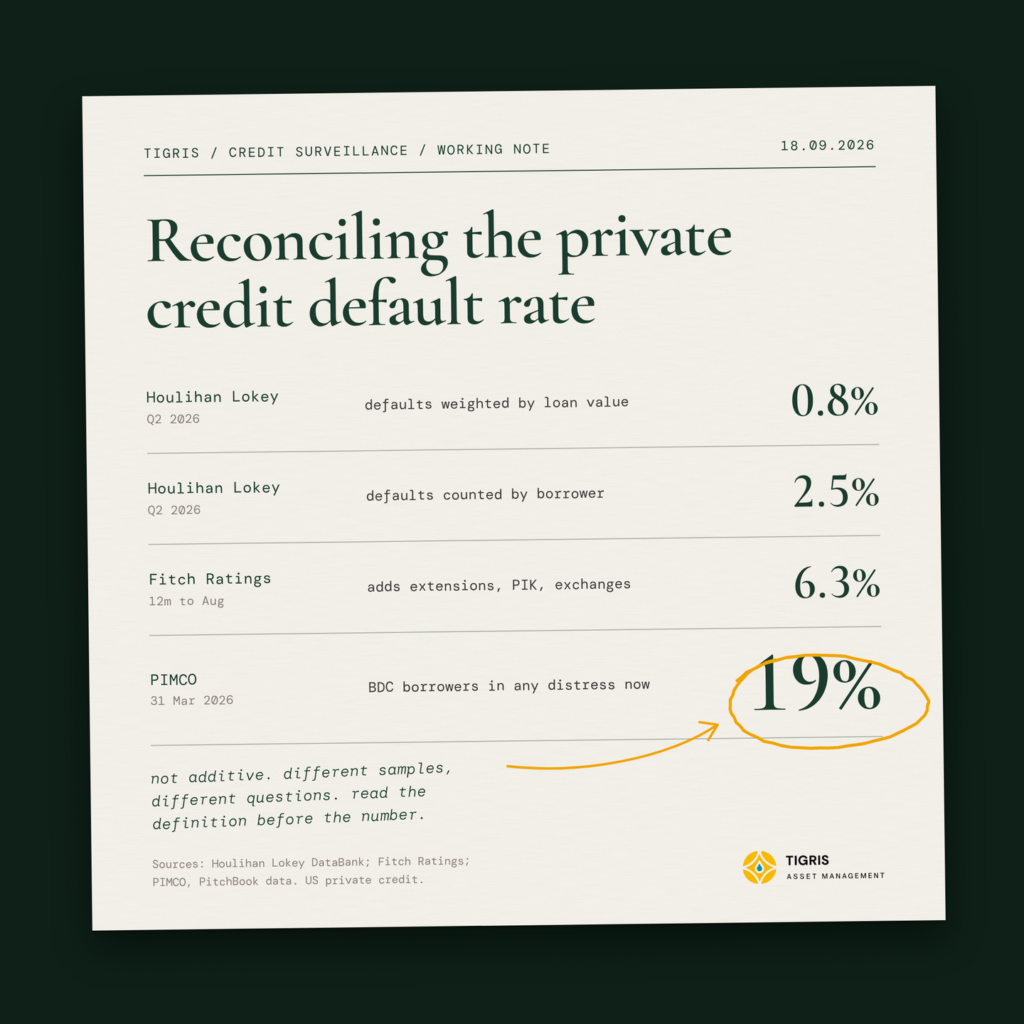
Short answer: Estimates of the US private credit default rate currently range from under 1% to 19%. That’s because each firm is measuring something different. Houlihan Lokey’s 0.8% weights defaults by the size of the loan. Fitch’s record 6.3% also counts loans that were quietly extended, or where interest was paid with more debt. PIMCO’s 19% is the share of BDC borrowers showing any sign of distress right now. None of these figures is wrong. But none of them, on its own, tells you how healthy a private credit investment really is.
If you hold private credit, or you’re thinking about it, this is worth ten minutes. The gap between these numbers isn’t a rounding issue. It tells you something real about how this market records trouble.
The numbers side by side
| Source | Rate | What it counts | Period |
|---|---|---|---|
| Houlihan Lokey | 0.8% | Defaulted loans as a share of money lent | Q2 2026 |
| Houlihan Lokey | 2.5% | Defaulted borrowers as a share of all borrowers | Q2 2026 |
| Proskauer | 2.51% | Senior secured and unitranche loans in its index | Q2 2026 |
| Fitch Ratings | 6.3% | US borrowers, including extensions and PIK, trailing 12 months | To end Aug 2026 |
| PIMCO | 19% | BDC borrowers currently in any of five distress states | As of 31 Mar 2026 |
Bloomberg summed up the confusion this week. Either private credit has a serious default problem or barely one at all, and the answer depends on who is doing the counting.
Why is the default rate so hard to measure in private credit?
In the public bond market, a default is hard to hide. The major rating agencies look for three things: a missed payment beyond the grace period, a bankruptcy, or a distressed exchange where the terms of the debt are rewritten. Each of these leaves a public record.
Private credit works differently. The loan is usually made by one lender or a small group. When a borrower struggles, the fix can be agreed privately. Stress can be handled through waivers, amend-and-extend deals, or switching cash interest to payment-in-kind. These can be economically the same as a distressed exchange without being classified as one.
Payment-in-kind, or PIK, simply means the borrower doesn’t pay interest in cash. The unpaid interest is added to the loan instead. The lender books the income, but no money has arrived.
Because most private loans are unrated, outside trackers have to rely on their own methods and definitions. That’s where the spread of numbers comes from.
What each number actually measures
Under 1%: weighting by money lent
Houlihan Lokey values a large share of the market’s loans, so its data is broad. In the second quarter, defaults affected 2.5% of borrowers by count but only 0.8% of loan principal.
Why the gap? Large borrowers are holding up, and large loans dominate a dollar-weighted average. Count the companies instead of the dollars and the picture changes.
The stress sits in the smaller borrowers. Around 12% of borrowers with less than $20 million of EBITDA had loans marked below 90 cents on the dollar in Q2, up from 1% in 2023. The figure was 6% for borrowers with $20 million to $100 million of EBITDA, and 3% for larger ones.
6.3%: counting the quiet fixes
Fitch’s trailing 12-month default rate across 1,300 borrowers rose to 6.3% at the end of August, above the previous high of 6.1% a month earlier.
Fitch’s number is higher because it counts restructurings that other measures leave out. According to reporting on the Fitch data, stress-driven maturity extensions made up 45% of August defaults. Interest deferrals and PIK arrangements made up 47% of defaults over the past year.
The stress is also uneven by sector. Healthcare and industrial companies both posted default rates of 9.9%, while software fell to 0.6%.
19%: a snapshot of distress, not an annual default rate
PIMCO’s figure is the one most likely to be misread. PIMCO counts a borrower as distressed if it hits any of five events. These are a payment default, non-accrual, a switch from cash interest to PIK after the loan was made, a material maturity extension, or a debt-to-equity swap.
It is also measured differently from the other rates. It is a stock measure: once flagged, a borrower stays classified as distressed while the condition lasts. PIMCO compares it to the 90-day-plus delinquency rate used in consumer credit. And it only covers loans held by business development companies, or BDCs, which are US funds that lend to mid-sized private businesses.
On this measure, distress has risen from roughly 14% in 2022 to 19%, although it has recently begun to level off. PIMCO also found that most of the default events are soft ones: debt-to-equity swaps, maturity extensions and cash-to-PIK conversions.
So 19% does not mean one in five loans defaulted this year. It means that, at the end of March, about one in five BDC borrowers was showing some sign of strain.
What the headline rate misses
The following is Tigris analysis and interpretation.
In private credit, calling something a default is partly a choice. A bond investor can’t decide whether a missed coupon counts. A private lender can often decide whether to push back a maturity or let interest roll up, and that decision affects whether the loan ever shows up as a default.
The incentives are not neutral. Amending a loan to allow PIK keeps it marked near par, keeps it classed as performing, and delays recognising the stress. For BDC managers whose net asset values, fees and incentive pay are linked to portfolio marks, the logic of amending is clear. We aren’t suggesting bad faith. We are saying that the lowest published number is also the one that relies most on the lender’s judgement.
Restructurings are now most of the story. This isn’t new in 2026. Moody’s estimated that the 2025 private credit default rate was somewhere between 1.6% and 4.7%, depending on whether distressed exchanges were included, and that distressed restructurings made up about 65% of all defaults that year. When two-thirds of defaults are negotiated rather than forced, the definition you choose largely decides the number you get.
Averages hide where the problem is. A portfolio full of large, well-financed borrowers will show a low dollar-weighted default rate even while its smaller loans deteriorate. If a fund leans towards smaller companies, the market-wide 0.8% has very little to do with its risk.
Why this matters more after this week’s Fed hike
Fact: On 16 September, the Federal Reserve raised its benchmark rate to a range of 3.75% to 4%, its first increase since July 2023. The decision was unanimous, and the median Fed official expects one more hike this year.
Interpretation: Most direct lending loans pay a floating rate, so a higher base rate feeds straight into borrowers’ interest bills. The companies that have already extended their loans or moved to PIK are the ones least able to absorb it.
Our expectation (a forecast, not a certainty): More amendments are likely, not fewer. If that happens, the gap between the narrow measures and the broad ones may widen. A stable headline default rate alongside a rising Fitch or PIMCO reading would not be reassuring. It would be the pattern we’d expect to see.
Five questions to ask your private credit manager
- Is your default rate measured by number of borrowers or by value? Ask for both.
- Do you count maturity extensions, PIK added after the loan was made, and debt-for-equity swaps as defaults? If not, ask how many there were.
- How much of last quarter’s interest income was received in cash? This is the hardest number to flatter. For BDCs it matters even more. They must distribute 90% of income whether it arrives as cash or PIK, and once PIK passes about 10% of total income, a cash shortfall can open up.
- How many loans were amended in the past 12 months, and why? Amendment activity often moves before defaults do.
- Who values the loans, and how are smaller borrowers marked? Independent valuation matters most where the stress is concentrated.
Does this apply outside the US?
Almost all the data above covers US private credit. The same definitional problem applies wherever loans are private and restructurings are negotiated behind closed doors, including in Asia. Investors in any private credit fund can ask the same five questions, whatever the market.
Frequently asked questions
What is the private credit default rate in 2026?
It depends on the measure. Houlihan Lokey reported 0.8% by loan value and 2.5% by borrower count for Q2 2026. Fitch reported a record 6.3% for the 12 months to August 2026. PIMCO’s broader distress measure for BDC borrowers stood at 19% as of March 2026.
Why do private credit default rates differ so much?
Firms use different definitions and samples. Some count only missed payments and bankruptcies. Others include maturity extensions, PIK conversions and debt-for-equity swaps. Weighting by loan value rather than borrower count also lowers the figure, because large borrowers are performing better.
What is a shadow default rate?
It’s an estimate of borrowers who are in trouble but haven’t formally defaulted. It usually counts events such as loans switched to PIK after the fact, extended maturities or debt-for-equity swaps. PIMCO and Lincoln International both publish versions.
What is PIK in private credit?
Payment-in-kind means interest is added to the loan balance instead of being paid in cash. It can be a legitimate feature if agreed when the loan is made. When it is added later because a borrower can’t pay, it is often a sign of stress.
Is private credit riskier than high-yield bonds right now?
PIMCO’s analysis suggests a credit cycle may be forming faster in direct lending than in other parts of leveraged finance, especially high-yield bonds. PIMCO itself calls the comparison imperfect, because the markets are measured differently.
What should investors look at instead of the headline default rate?
Look at the share of interest received in cash, the number of amendments, how PIK added after origination is treated, and how smaller borrowers are performing. Ask for default rates by both count and value.
Sources
- Bloomberg, “Private Credit Defaults Are 1%, 6% or 19%, Depending Who You Ask”, 17 September 2026
- Fitch Ratings, US private credit default rate, August 2026, via Bloomberg and secondary reporting
- Houlihan Lokey, Private Credit DataBank, Q2 2026, via PitchBook, 10 September 2026
- PIMCO, “The Credit Market Lens: Narrowing the Visibility Gap in Defaults”, 24 August 2026
- Moody’s, “US corporate default risk in 2026”, April 2026
- ABF Journal, “The PIK Divide”, June 2026
- iCapital, “Painting a PIKture”, October 2025
- Federal Reserve, FOMC statement, 16 September 2026
More analysis from our team is on the Tigris Insights page.
This material is for informational purposes only and does not constitute an offer or solicitation to buy or sell any investment product. Past performance is not indicative of future results. Investment products are available only to accredited and institutional investors as defined under the Securities and Futures Act 2001 of Singapore. Tigris Asset Management Pte Ltd holds Capital Markets Services Licence CMS101520 issued by the Monetary Authority of Singapore.
