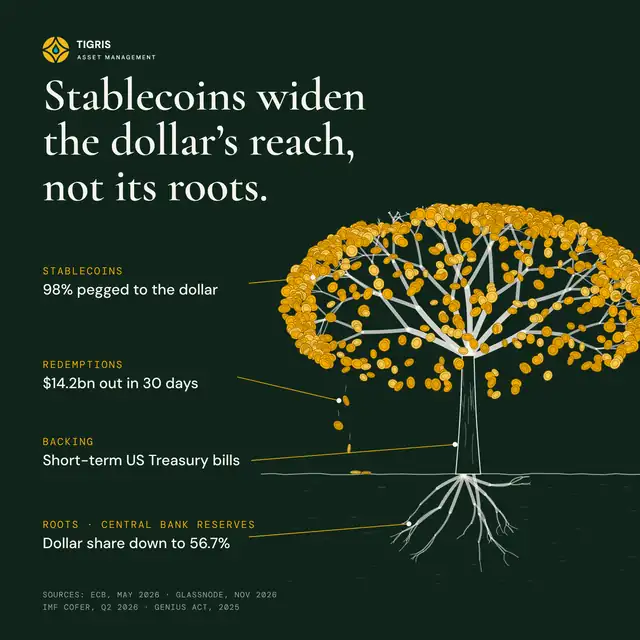
The short answer: Stablecoins have widened the US dollar’s reach, but there is little evidence yet that they have strengthened its status as the world’s reserve currency. They put dollars into the hands of people outside the US banking system, and they have become a real buyer of short-term US government debt. Central banks, however, hold a smaller share of their reserves in dollars today than they did before the latest stablecoin boom. Washington is openly backing stablecoins to protect the dollar’s position, and the GENIUS Act is designed to channel their growth into US Treasury bills. For investors, the more useful way to see stablecoins is as a new and fickle buyer at the short end of the US yield curve, and as a channel for digital dollarisation in emerging markets. They are not a support for the dollar’s exchange rate or for long-dated US bonds.
Key Takeaways
- Coinbase chief executive Brian Armstrong said on 14 November 2026 that stablecoins have strengthened the dollar’s reserve currency status “massively”.
- Around 98% of stablecoins are pegged to the dollar. Tether’s USDT (about 60% of supply) and Circle’s USDC (about 24%) dominate the market.
- The dollar’s share of global central bank reserves was 56.7% in mid-2026, down from 58.5% in early 2025, even as stablecoin supply grew by about half.
- Stablecoin issuers added about $200 billion of US Treasuries over five years, more than 40% of China’s reduction, but almost all of it in short-dated bills.
- The White House framed the GENIUS Act, signed in July 2025 and effective on 18 January 2027, as a way to create demand for US debt and protect the dollar’s reserve role.
- Stablecoin supply fell by $14.2 billion in the 30 days to 10 November 2026. This new source of demand moves with crypto sentiment.
What Brian Armstrong Said, and Why It Deserves Testing
On 14 November 2026, Brian Armstrong posted on X: “Stablecoins strengthened the US dollar’s reserve currency status massively.” The claim landed at a sensitive moment. Many investors are asking whether the dollar’s long dominance is fading, and whether China’s yuan could one day take its place.
Armstrong is not a neutral observer. Coinbase shares the interest earned on the reserves behind USDC with its issuer, Circle, and says it captured roughly half of all USDC economics over the past year. Its stablecoin revenue was about $307 million in the third quarter of 2026, close to a quarter of total revenue of $1.22 billion, according to the company’s results and The Block. That does not make the claim wrong. It does mean the claim should be tested against data.
The statement has two parts. The first is that stablecoins spread the dollar’s use around the world. The second is that this makes the dollar a stronger reserve currency. The first is largely true. The second is where the evidence thins out.
What Is a Stablecoin, and Which Ones Matter?
A stablecoin is a digital token designed to hold a fixed value, usually one US dollar. The issuer holds cash and short-term government debt in reserve and promises to swap each token back for a dollar. People use stablecoins to trade crypto, to move money across borders quickly, and, in countries with weak currencies, to save in dollars without a US bank account.
It is almost entirely a dollar market. ECB President Christine Lagarde noted in May 2026 that nearly 98% of stablecoins are pegged to the dollar. It is also highly concentrated in two tokens.
| Stablecoin | Issuer | Approximate supply | Share of market | What backs it | Position under US law |
|---|---|---|---|---|---|
| USDT | Tether | About $184 billion | About 60% | Mostly US Treasury exposure, plus gold, bitcoin, secured loans, and other investments | Offshore issuer. Needs a Treasury finding that its home regime is comparable to stay on US platforms after July 2028 |
| USDC | Circle | About $73 to $74 billion | About 24% | Cash and short-dated US Treasuries | Built for the US framework |
| All others | Various | The remainder | About 15% | Varies widely | Varies |
Sources: Crypto Briefing, Tether Q3 2026 attestation via Stablecoin Insider, Coinbase Q3 2026. Shares are approximate and vary by tracker.
So yes, USDT and USDC are by far the most used, but in different ways. USDT dominates trading on crypto exchanges, where it accounts for around three-quarters of stablecoin volume. USDC has led on adjusted on-chain settlement volume for much of 2026, which points to heavier use in payments and institutional transfers.
Total supply now sits at roughly $280 billion to $300 billion depending on the tracker, after peaking above $310 billion in May 2026.
What Does “Reserve Currency” Actually Mean?
A reserve currency is the currency central banks hold most of their foreign exchange reserves in, and the one the world uses most for trade, borrowing, and financial transactions. It is measured in several ways:
- Official reserves. The dollar made up 56.70% of global foreign exchange reserves in the second quarter of 2026, down from 57.18% in the first quarter, according to the IMF’s COFER data. The renminbi was 2.11%.
- The long trend. The dollar’s reserve share has fallen from more than 72% at its 2001 peak.
- Market plumbing. The dollar was on one side of 89.2% of all foreign exchange trades in April 2025, according to the BIS Triennial Survey.
The distinction matters because stablecoins are private money held by private users. They do not appear in central bank reserve statistics. A small business owner in a high-inflation economy who saves in USDT is strengthening the dollar’s role as a private store of value. That does nothing directly to the share of dollars held by the People’s Bank of China or the Reserve Bank of India.
Where Armstrong Is Right: Three Ways Stablecoins Extend the Dollar
1. They export dollars to people that banks do not reach
In countries with high inflation or capital controls, a phone and a stablecoin wallet are now enough to hold dollars. Armstrong has described this as part of American soft power. European central bankers agree on the mechanism, if not the merits. ECB board member Isabel Schnabel warned in June 2026 that dollar stablecoins could cement dollar dominance through network effects and widen the international reach of US monetary policy.
2. They have become a real buyer of US government debt
Stablecoin reserves must sit in cash and very short-term US government debt, so a bigger stablecoin market means more demand for Treasury bills. A September 2026 study by the Federal Reserve Bank of San Francisco found that Tether and Circle increased their Treasury holdings by about $200 billion over five years, more than 40% of the decline in China’s holdings over the same period. Since 2023, they have added more short-term Treasuries than Japan, the largest foreign holder. Tether alone reported about $132 billion of US Treasury exposure at the end of September 2026.
That matters in Washington. The same study shows the share of US Treasuries held by foreigners has fallen from more than 50% around 2008 to about 30% in early 2026. Any new buyer is welcome.
3. They extend US legal reach
The GENIUS Act requires stablecoin issuers, including foreign issuers whose tokens are offered in the US, to have the technical ability to freeze, seize, or burn tokens under a lawful order (Skadden summary). A global payment network that settles in dollars and answers to US court orders extends Washington’s enforcement reach well beyond its banks. For the US, that is a feature. For some governments, it is the reason to keep dollar stablecoins out.
Where the Claim Runs Ahead of the Evidence
Central banks have been holding a smaller share of dollars, not a larger one
If stablecoins had “massively” strengthened the dollar’s reserve status, it should show up in the reserve data. It has not. Stablecoin supply rose by about 49% in 2025, from $205 billion in January to $306 billion by late November, according to DefiLlama data cited by Decrypt. Over a similar period, the dollar’s share of global reserves slipped from 58.51% in the first quarter of 2025 to 56.70% in the second quarter of 2026. The dollar index also fell nearly 10% in 2025, its weakest year in eight.
Neither trend proves anything about the other. They do show that stablecoin growth and official reserve demand are separate forces.
The Treasury demand is real, but small and short
Treasury’s own borrowing advisers note that stablecoin issuers hold less than 1% of outstanding Treasuries. The San Francisco Fed projects that issuers’ short-term Treasury demand could roughly double to about $400 billion by the end of 2030 if recent trends continue. Even then, it says, those holdings would remain “a small part of the U.S. government’s financing needs.”
Maturity matters more than size. China has mostly sold longer-dated bonds. Under US rules, stablecoin issuers can only buy Treasuries maturing within 93 days. The pressure on US borrowing costs this year has been at the long end: the 10-year Treasury yield rose above 5% in mid-September 2026, its highest level in 19 years. Stablecoins cannot absorb that duration directly. They help only indirectly, by giving the Treasury room to issue more bills and fewer bonds. That shortens the average maturity of US debt and means it has to be refinanced more often.
Some of the new demand is not new
When an American moves money from a bank deposit or a money market fund into USDC, no new demand for US debt is created. It simply changes who holds it. Treasury’s borrowing advisers have flagged exactly this point. The genuine gain comes mainly from foreign money that would not otherwise have been in dollars, which is the flow emerging market central banks are least comfortable with.
The demand moves with crypto sentiment
Stablecoin supply fell by $14.2 billion in the 30 days to 10 November 2026, the sharpest monthly contraction since 2022, according to Glassnode data reported by The Block. A Bank for International Settlements working paper found that stablecoin inflows lower three-month Treasury bill yields by a few basis points, while outflows push them up by two to three times as much. A buyer that retreats when crypto markets fall is not the steady, policy-driven holder that central banks have historically been.
The largest dollar stablecoin is not a pure Treasury fund
Tether’s third-quarter 2026 attestation, prepared by BDO, showed $191.45 billion of assets against $183.5 billion of tokens issued. Around 27% of those assets sat in gold ($19.08 billion), secured loans ($14.18 billion), bitcoin ($8.37 billion), other investments ($6.0 billion), and listed equities ($4.18 billion), according to Stablecoin Insider’s analysis of the report. None of these are eligible reserve assets under the GENIUS Act. An attestation is also not a full audit. The world’s most widely held digital dollar carries credit and market risk inside its reserves.
Is This Why the US Is Pushing Stablecoins? The GENIUS Act Explained
Yes, in large part, and the government says so openly. When President Trump signed the GENIUS Act on 18 July 2025, the White House fact sheet said it would increase demand for US debt and “cement the dollar’s status as the global reserve currency”. Trump told the signing ceremony that losing that status would be “like losing a world war”.
The aim has not faded. Treasury’s August 2026 proposed rule restated the goal of securing the dollar’s reserve role, and in September 2026 Bloomberg reported that the administration was weighing a programme to promote dollar stablecoins overseas, potentially involving the State Department, Treasury, and the US International Development Finance Corporation (PYMNTS).
Treasury Secretary Scott Bessent has been just as direct about funding. He has said the stablecoin market could grow tenfold to around $3 trillion by 2030. On 27 October 2026 he described dollar stablecoins as a potential “important source of demand for federal government funding”, especially if adoption grows in emerging markets.
What the GENIUS Act requires
- Full backing. At least one dollar of reserves for every token, held in cash, bank deposits, Treasuries maturing within 93 days, Treasury repurchase agreements, or government money market funds.
- Monthly disclosure. Reserve reports published every month, examined by a registered accounting firm and certified by senior executives.
- No yield. Issuers may not pay interest to holders.
- Holders first. Token holders rank ahead of other creditors if an issuer fails.
- Enforcement. Issuers must be able to freeze, seize, or burn tokens under lawful orders.
- Foreign issuers. They must come from a regime Treasury judges comparable, register with the Office of the Comptroller of the Currency (OCC), and hold reserves in US institutions for US customers (Orrick summary).
- Timeline. The Act and the OCC’s final implementing rule of 21 October 2026 take effect on 18 January 2027. US platforms must stop offering non-compliant stablecoins from 18 July 2028. Tether has launched a separate, US-compliant token, USAT, while seeking a path for USDT (Crypto Briefing).
The other motives
Dollar dominance is not the only driver. The law also reflected a political choice to let private firms, rather than the Federal Reserve, issue digital dollars. House conservatives held up the bill until they were promised separate action against a central bank digital currency. The crypto industry was a prominent supporter of the administration. And there is a strategic contest with China, which is promoting its own state-controlled digital yuan.
Tigris view: of the stated goals, Treasury funding may be the most immediate. The design gives it away. By limiting reserves to instruments of 93 days or less, the Act directs every new dollar of stablecoin demand into the part of the market the Treasury can most easily expand. The reserve currency language describes the ambition. The reserve rules describe the mechanism.
Could the Yuan Replace the Dollar?
Not on current evidence. A decade after joining the IMF’s reserve basket, the renminbi made up 2.11% of global reserves in mid-2026, and it was involved in about 8.5% of global FX trading in 2025. Capital controls and a managed exchange rate limit its appeal to reserve managers, who need to be confident they can sell quickly and in size.
Beijing’s answer to dollar stablecoins has been to keep digital money under state control. In February 2026, the People’s Bank of China and other agencies banned unapproved yuan-pegged stablecoins, onshore and offshore. The digital yuan began paying interest on 1 January 2026, and the central bank has signed up financial institutions for cross-border e-CNY payments. Hong Kong granted its first stablecoin issuer licences to HSBC and Anchorpoint on 10 April 2026, but both are starting with Hong Kong dollar tokens, not yuan (East Asia Forum).
The more realistic risk to the dollar is not replacement but fragmentation. Private dollar networks sit on one side. State-run digital money sits on the other, in China today and potentially in Europe, where the ECB aims to be ready to issue a digital euro by 2029. Lagarde has argued that euro stablecoins are not an efficient way to strengthen the euro’s global role.
What the Market May Be Overlooking
The points in this section are Tigris interpretation, not reported fact.
Savers abroad are lending to Washington at zero interest, through a middleman
Because the GENIUS Act bars issuers from paying yield, a stablecoin holder in an emerging market effectively makes an interest-free loan to the issuer. The issuer lends it on to the US Treasury at bill rates and keeps the spread. Tether reported $1.5 billion of net operating profit in the third quarter of 2026 alone. This is a modern version of the dollar’s old “exorbitant privilege”, except that much of the benefit sits with private issuers and their distribution partners. It also explains why the fight over stablecoin rewards in the separate CLARITY Act has been so bitter. Armstrong himself withdrew Coinbase’s support for the bill in January 2026 over limits on rewards. Whoever controls that spread controls the economics of digital dollars.
The dollar’s newest marginal buyer is a crypto sentiment indicator
Central banks buy Treasuries for policy reasons and rarely sell in a hurry. Stablecoin issuers buy when crypto traders want dollar liquidity and sell when they leave. As stablecoins grow, demand for short-dated Treasuries becomes more sensitive to crypto cycles, and the BIS evidence suggests the selling effect is the stronger one.
Two digital dollars are emerging
One is onshore, regulated, and backed by bills and cash. The other is offshore, larger, and backed partly by gold, bitcoin, and loans to borrowers the market cannot see. This is a credit question dressed up as a currency question. Tether says its secured loans are overcollateralised and subject to margin calls. The attestation does not name the borrowers. In credit, risk tends to sit in the gap between what is reported and what was actually underwritten. Promising instant redemption against assets that cannot be sold instantly is the same tension we described in tokenised private credit.
Emerging markets will import US monetary policy more directly
When households hold savings in digital dollars, a domestic central bank loses part of its grip on its own economy. US rate decisions reach those households more directly, and local bank deposits can drain quickly when confidence falls. We expect more emerging market governments to restrict stablecoin use, not fewer.
What It Means for Investors
- Rates and cash. Treat stablecoin supply as a high-frequency signal of demand for short-dated Treasury bills. Growth supports bill prices at the margin. Sharp redemptions push the other way, and faster. If the Treasury leans further on bills, US debt becomes shorter-dated and more sensitive to the Fed’s policy rate.
- Long-dated US bonds. Stablecoins do not buy them. The question of who funds US deficits at the long end is unchanged, and term premium risk remains.
- Currency. Do not read stablecoin growth as a reason to be long the dollar. In 2025, stablecoins grew by about half while the dollar index fell nearly 10%. Anchor currency views to rates, growth, and policy.
- Emerging market credit and banks. Where stablecoin use is high, watch for erosion of local bank deposits, tighter capital controls, and policy moves against digital dollars. For lenders, check whether a borrower’s cash flows and collateral stay within reach of your legal claim.
- US banks. How the CLARITY Act treats stablecoin rewards will decide how hard stablecoins compete for deposits. That outcome matters more for bank funding costs than headline stablecoin growth.
- Anyone holding stablecoins for settlement. Know what backs the token you hold. From January 2027, compliant US issuers must publish reserves monthly. Prefer reserves of cash and bills, read the redemption terms, and do not treat an attestation as an audit.
What to Watch Next
- 18 January 2027: the GENIUS Act takes effect.
- Treasury “comparable regime” decisions: these determine whether USDT can stay on US platforms after 18 July 2028.
- The next IMF COFER release: any sign of a turn in the dollar’s reserve share.
- Monthly stablecoin supply: a practical gauge of short-end Treasury demand.
- The CLARITY Act: how it treats stablecoin rewards and yield.
- Treasury’s quarterly refunding: decisions on the share of bills in new issuance.
- China and Europe: cross-border e-CNY adoption and progress on the digital euro legislation.
Facts, Interpretation, and Forecasts
| Statement | Type | Basis |
|---|---|---|
| Armstrong said stablecoins strengthened the dollar’s reserve status “massively” | Fact | Post on X, 14 November 2026 |
| Nearly 98% of stablecoins are pegged to the dollar | Fact | ECB, May 2026 |
| The dollar held 56.70% of global reserves in Q2 2026 | Fact | IMF COFER |
| Issuers added about $200 billion of Treasuries, more than 40% of China’s decline | Fact | San Francisco Fed, September 2026 |
| The GENIUS Act takes effect on 18 January 2027 | Fact | OCC final rule |
| Stablecoins strengthen the dollar’s private reach more than its official reserve role | Interpretation | Tigris analysis of the data above |
| Treasury funding is the most immediate policy motive | Interpretation | Tigris analysis of the reserve rules |
| The stablecoin market could reach about $3 trillion by 2030 | Forecast | Treasury Secretary Bessent, not Tigris |
| Issuers’ short-term Treasury demand could reach about $400 billion by 2030 | Forecast | San Francisco Fed, described as highly uncertain |
| More emerging market governments will restrict stablecoins | Forecast | Tigris view |
Frequently Asked Questions
Do stablecoins strengthen the US dollar’s reserve currency status?
They strengthen the dollar’s use by private individuals and businesses around the world, and they add demand for short-term US Treasuries. They have not lifted the dollar’s share of central bank reserves, which was 56.7% in mid-2026 and has drifted lower while stablecoins grew.
What did Brian Armstrong say about stablecoins and the dollar?
On 14 November 2026, the Coinbase chief executive posted on X that stablecoins strengthened the US dollar’s reserve currency status “massively”. Coinbase earns a large share of the income on USDC reserves, so it has a direct commercial interest in stablecoin growth.
Which stablecoins are used most?
Tether’s USDT and Circle’s USDC together make up about 85% of stablecoin supply. USDT holds about 60% and dominates exchange trading. USDC holds about 24% and leads on adjusted settlement volume.
What is the GENIUS Act?
The GENIUS Act is the US federal law for payment stablecoins, signed on 18 July 2025. It requires one-for-one reserves in cash and short-term Treasuries, monthly reserve disclosure, no interest paid to holders, priority for holders in insolvency, and the ability to freeze tokens under lawful orders.
When does the GENIUS Act take effect?
On 18 January 2027, alongside the OCC’s final implementing rule. From 18 July 2028, US platforms may no longer offer stablecoins from issuers that do not comply.
Why does the US government support dollar stablecoins?
The White House and Treasury have said stablecoins will create demand for US debt and protect the dollar’s role as the global reserve currency. Other motives include preferring private digital dollars to a Federal Reserve digital currency, and competing with China’s digital yuan.
Could the Chinese yuan replace the dollar as the world’s reserve currency?
It is unlikely in the foreseeable future. The renminbi held 2.11% of global reserves in mid-2026, against 56.7% for the dollar, and China’s capital controls limit its use. China has banned unapproved yuan stablecoins and is promoting its state-run digital yuan instead.
How do stablecoins affect US Treasury yields?
BIS research finds that stablecoin inflows lower three-month Treasury bill yields by a few basis points, while outflows raise them by two to three times as much. There is little measurable effect on longer maturities.
What are the risks of dollar stablecoins for emerging markets?
They can draw savings out of local banks and currencies, weaken a central bank’s control over its own economy, and make capital flight easier in a crisis. This is why several central banks, including the ECB and the People’s Bank of China, are building or protecting their own alternatives.
Is USDT compliant with the GENIUS Act?
Not yet. Tether is an offshore issuer and needs the US Treasury to find its home regime comparable before USDT can remain on US platforms after July 2028. Around 27% of its reserves are in assets the Act does not allow. Tether launched a separate token, USAT, for the US market in January 2026.
Sources
- Brian Armstrong on X, 14 November 2026
- IMF, COFER Data Brief, 30 September 2026
- Federal Reserve Bank of San Francisco, Stablecoin Issuers’ Growing Appetite for Treasury Securities, 28 September 2026
- BIS Working Paper 1270, Stablecoins and Safe Asset Prices
- BIS Triennial Central Bank Survey, September 2025
- White House, GENIUS Act fact sheet, July 2025
- OCC, Final Rule to Implement the GENIUS Act, 21 October 2026
- Orrick, Stablecoin Framework Signed into Law
- PYMNTS, US Looks to Stablecoins to Bolster Dollar’s Reserve Status
- American Banker, Bessent remarks, 27 October 2026
- The Block, Stablecoin supply drops $14.2 billion, 11 November 2026
- Stablecoin Insider, Tether Q3 2026 attestation
- The Block, Lagarde on euro stablecoins, 8 May 2026
- East Asia Forum, Beijing draws the line on digital dollars
For more of our research on credit, markets, and financial system structure, visit Tigris Insights.
This article is for information only and does not constitute investment, legal, or tax advice, or an offer or solicitation to buy or sell any security or digital asset. Views marked as Tigris interpretation or forecast are opinions and may change without notice. Tigris Asset Management Pte Ltd holds Capital Markets Services Licence CMS101520 issued by the Monetary Authority of Singapore.
