Fed interest rate outlook 2026
The Federal Reserve held the federal funds rate at 3.50%-3.75% in July, but the decision was not a neutral pause. Three policymakers voted for an immediate 25-basis-point increase, revealing a significant tightening bloc inside the Committee. Our Fed interest rate outlook for 2026 is therefore revised from no change to zero to one hike, with September now the most important decision point.
The more important conclusion is that the distribution of outcomes has widened. No further increase remains plausible if inflation moderates and higher market yields continue to tighten financial conditions. One hike is now a credible base-case outcome. A sequence of two increases cannot be dismissed if energy costs and underlying inflation stay firm.
This is no longer a market debating the precise timing of a well-telegraphed policy move. Chair Kevin Warsh has deliberately reduced forward guidance. Investors must now price each inflation release, labour-market report and movement in financial conditions with less help from the Federal Reserve.
Key takeaways from the July FOMC meeting
- The Federal Open Market Committee voted 9-3 to maintain the federal funds target range at 3.50%-3.75%.
- Beth Hammack, Neel Kashkari and Lorie Logan dissented in favour of a 25-basis-point hike.
- Markets initially interpreted Chair Warsh’s press conference as less hawkish than expected, reducing the implied probability of a September increase.
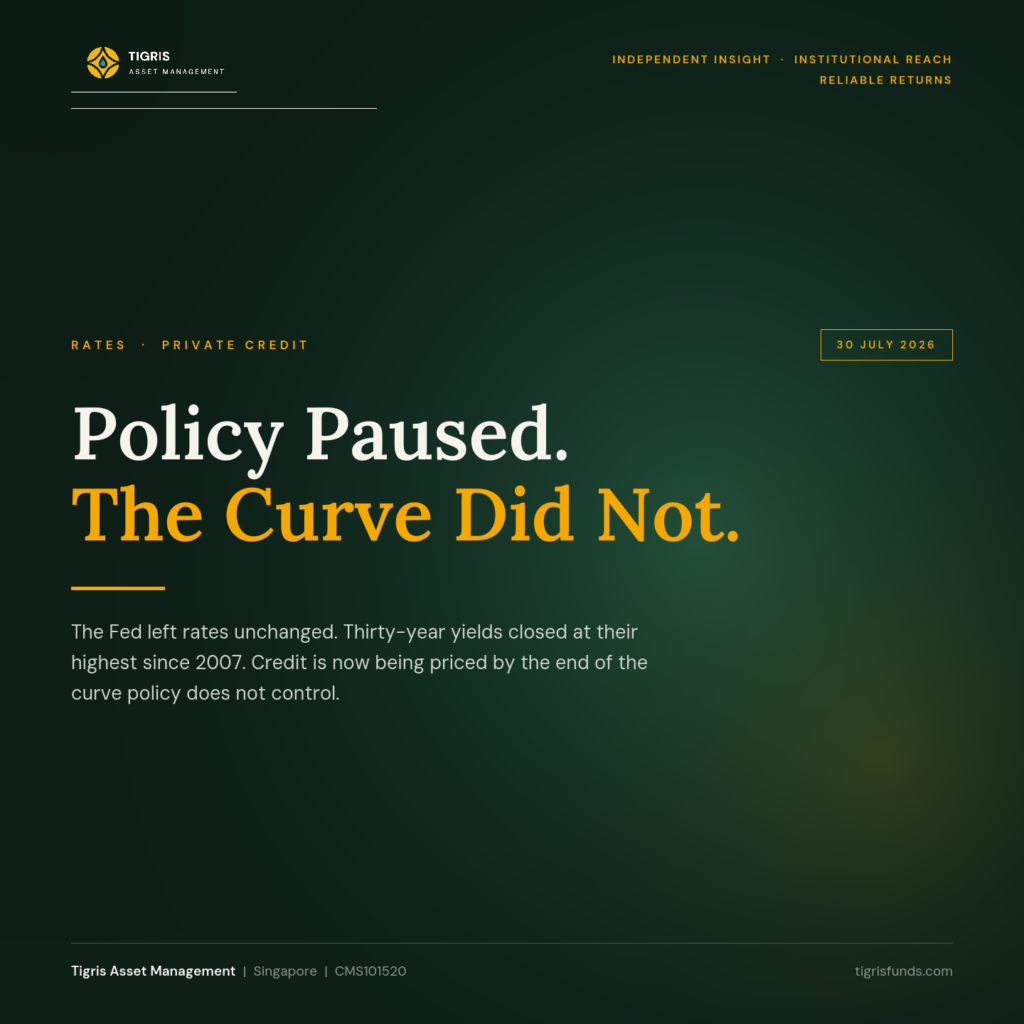
- The Treasury curve steepened as short yields eased but long yields rose, suggesting greater concern about inflation credibility and term risk.
- Our base case is now zero to one hike in 2026, with meaningful risks on both sides.
- The two inflation reports before the September meeting, speeches from core FOMC voters and Warsh’s Jackson Hole remarks will be critical.
What did the Federal Reserve decide in July 2026?
The FOMC voted 9-3 on 29 July to keep the target range for the federal funds rate at 3.50%-3.75%. The official FOMC statement described economic activity as expanding at a solid pace, with strong productivity, capital investment and a stable labour market. It also said inflation remained elevated relative to the Fed’s 2% objective, partly because of supply shocks and higher energy prices.
The statement was deliberately brief and changed little from June. It did not identify a likely next move or provide a threshold for action.
That continuity should not be mistaken for consensus. Cleveland Fed President Beth Hammack, Minneapolis Fed President Neel Kashkari and Dallas Fed President Lorie Logan all preferred an immediate quarter-point increase. The hold won comfortably, but the dissents established that a significant part of the Committee believes current policy may not be restrictive enough.
Why was the vote more hawkish than the decision?
A policy decision has two components: what the Committee did and how difficult it was to reach that decision.
The Fed did not raise rates. Yet three voting regional presidents concluded that an increase was already warranted despite materially higher Treasury yields and tighter financial conditions since June. This matters because dissenters can influence the centre of the Committee even when they do not prevail.
The July vote also changes the burden of proof for future meetings. Before this decision, advocates of a hike had to establish that inflation risks justified restarting the tightening cycle. After three formal dissents, the debate becomes more balanced. If the next two inflation reports remain firm, officials supporting another hold will need to explain why market tightening is sufficient without a policy-rate response.
This is why we have revised our 2026 view. The Committee has not committed to raising rates, but it has revealed a clearer tightening bias.
Why did markets read the press conference as less hawkish?
Chair Warsh repeated the Fed’s commitment to price stability but did not translate that commitment into a policy path. His opening statement emphasised that nominal and real Treasury yields had risen materially between meetings. He suggested that reduced forward guidance may have allowed markets to respond more directly to economic data.
The implication was important. If market rates have already tightened financial conditions, the Fed may not need to validate every rise in yields with an immediate increase in the policy rate.
That helped explain the initial decline in short-term hike expectations. Reuters reported that the implied probability of a September hike fell to about 57% immediately after the decision, after approaching 100% before the meeting. By 30 July, it had recovered to roughly 65%, according to subsequent Reuters reporting.
The precise percentage will continue to change. The more durable signal is that markets moved from treating September as nearly predetermined to recognising a genuine two-sided decision.
Why did the Treasury yield curve steepen after the Fed held rates?
The immediate bond-market reaction separated the expected path of the policy rate from the longer-term inflation outlook.
The two-year Treasury yield fell by roughly 2 basis points as investors reduced the probability of a near-term hike. In contrast, the 10-year yield rose by about 7 basis points and the 30-year yield by approximately 12 basis points. The increase in the 10-year yield was driven largely by higher breakeven inflation rather than a comparable rise in real yields.
This is a bear-steepening signal at the long end, even though the front end rallied modestly. Investors were not simply celebrating a pause. They were questioning whether leaving rates unchanged would allow inflation risk to persist for longer.
That distinction matters for asset allocation. A stable policy rate does not guarantee stable borrowing costs. Mortgages, corporate debt, infrastructure financing and equity discount rates are influenced by longer-maturity yields. If term premium and inflation compensation rise, financial conditions can tighten even while the Fed remains on hold.
The July meeting therefore produced an unusual outcome: less confidence in a September hike, but more concern about long-duration inflation risk.
Why is our 2026 base case now zero to one hike?
Our previous expectation was for the Fed to remain on hold through 2026. We now see zero to one increase as the most reasonable central case.
Three considerations support the revision.
1. The Committee has disclosed a meaningful tightening constituency
Three dissents are not enough to determine policy, but they show that the argument for higher rates is established inside the voting Committee. A modest upside inflation surprise could move additional members towards a hike.
2. Inflation credibility has become part of the reaction function
The rise in long-term yields and inflation compensation suggests that the Fed must consider not only realised inflation, but also whether markets believe it will deliver the 2% objective. A delayed hike could become more likely if officials judge that credibility is deteriorating.
3. Higher market yields are already doing part of the work
The case for no further increase is also credible. Real and nominal yields have risen materially, tightening borrowing conditions without a change in the federal funds rate. If inflation data improve, the Committee can argue that policy transmission is occurring through markets.
These forces point in opposite directions. That is why a precise forecast of one hike would overstate confidence. Zero to one is not indecision. It reflects a genuinely wider policy distribution.
What are the main Fed scenarios for the rest of 2026?
| Scenario | What would support it? | Likely policy outcome |
|---|---|---|
| Inflation moderates | Softer core inflation, stable energy prices, slower wage pressure and persistently high real yields | No further hike |
| Inflation remains firm | Core inflation stays above a pace consistent with 2%, the labour market remains resilient and long-term inflation expectations rise | One 25-basis-point hike |
| Inflation reaccelerates | Further energy shocks, broadening price pressure and stronger evidence that expectations are becoming less anchored | One to two hikes |
| Growth deteriorates sharply | Material labour-market weakness, tighter credit conditions or a rapid fall in demand | Hikes removed from consideration, with cuts becoming possible |
The no-hike and one-hike scenarios are both central possibilities. Two hikes remain a meaningful risk case rather than our base case. Rate cuts would require clearer evidence that economic weakness has overtaken inflation as the dominant risk.
Why is the September FOMC meeting pivotal?
The next scheduled FOMC decision is on 16 September. According to the Federal Reserve’s meeting calendar, it will include a new Summary of Economic Projections. The Committee will receive two additional monthly inflation reports and two labour-market reports before then.
September matters for four reasons:
- The data window is unusually informative. Two inflation reports will show whether recent price pressure is persistent or temporary.
- The Committee is already divided. Another firm inflation print could convert private concern into additional votes for tightening.
- Jackson Hole will shape the reaction function. Chair Warsh’s remarks at the end of August may clarify how the Fed weighs market yields against realised inflation.
- The October meeting is politically awkward. The 27-28 October meeting falls less than a week before the US midterm elections. The Fed is institutionally independent and can act when required, but the timing increases the communication burden.
September is therefore the cleanest opportunity for a 2026 move. A December increase remains possible if the Committee wants more evidence or if September data are inconclusive.
Why are major banks reaching different conclusions?
The July meeting gave analysts enough evidence to support opposing forecasts.
J.P. Morgan moved its expected next hike to December 2026 from the second half of 2027, arguing that the Committee may eventually need to act to preserve inflation credibility. Bank of America has taken a more hawkish view, while Goldman Sachs and Barclays expect no change through year-end.
Citigroup remains on the other side of the debate, maintaining a forecast for rate cuts later in 2026. Its argument is that Warsh’s attention to a broad range of inflation measures, combined with his acknowledgement of higher real yields, suggests the Fed may allow market tightening to do more of the work.
This disagreement is not simply a difference in inflation forecasts. It reflects different assumptions about the Fed’s reaction function:
- Will the Committee respond primarily to realised inflation?
- Will it react to rising inflation expectations before they appear in consumer prices?
- How much weight will it place on higher real yields?
- Will institutional credibility require an actual hike, or can tighter market conditions substitute for one?
Until Warsh answers those questions more directly, policy uncertainty will remain structurally higher.
What does the Fed decision mean for bonds and credit?
For bond investors, the July meeting showed why a stable policy rate does not eliminate duration risk. The front end can rally on reduced hike expectations while the long end sells off on higher inflation compensation and term premium.
Investors should separate three exposures that are often grouped together:
- Policy-rate exposure: Most visible in the front end of the Treasury curve.
- Inflation-expectation exposure: More important for nominal long-duration bonds.
- Term-premium exposure: Influenced by fiscal supply, policy uncertainty and the compensation required to hold duration.
For private credit, zero to one additional hike may support floating-rate income, but the benefit is not automatic. Higher base rates also increase borrower debt-service burdens, weaken interest coverage and raise refinancing risk. The relevant question is not whether a loan earns a higher coupon, but whether the borrower can pay it in cash.
This is particularly important where interest has been converted to payment-in-kind or maturities have been extended. Our earlier analysis, Private Credit PIK Loans Were Underwrittenhttps://tigrisfunds.com/private-credit-pik-loans-were-underwritten-for-a-rate-cut-the-market-is-now-pricing-a-hike/ for a Rate Cut, explains why higher-for-longer rates can expose the assumptions embedded in those amendments.
What does the decision mean for the US dollar and USDJPY?
The US dollar initially weakened after the meeting as markets reduced the probability of an immediate follow-through hike. DXY fell by roughly 0.6% in the initial reaction, while USDJPY moved lower. The dollar subsequently recovered part of that decline in Asian trading as renewed geopolitical risk supported demand for the currency.
The medium-term USDJPY outlook remains shaped by a wide US-Japan rate differential. The Bank of Japan’s policy rate is 1%, while the federal funds range remains 3.50%-3.75%. That gap continues to support the dollar against the yen, even if the Fed makes no further move this year.
The near-term path is less straightforward. The Bank of Japan meets on 30-31 July, and markets expect it to hold rates after its June increase. Governor Kazuo Ueda’s communication will matter more than the decision itself. A hawkish signal could reduce pressure on the yen, while a cautious message may reopen USDJPY upside and raise the risk of official intervention.
Our base case is therefore for a broadly higher USDJPY trajectory over time, interrupted by sharp episodes of volatility driven by Bank of Japan communication, energy prices and intervention risk.
What should investors watch before September?
The most useful indicators are those that reveal whether inflation is broadening and whether existing market tightening is affecting demand.
Watch:
- July and August core CPI, particularly the three-month annualised trend
- Shelter, services and wage-sensitive inflation components
- Energy-price pass-through into transport and production costs
- Two-year Treasury yields as a measure of policy expectations
- Ten-year breakeven inflation and long-end term premium
- Labour-market data, especially unemployment, payroll growth and hours worked
- Credit spreads and bank lending conditions
- Speeches from core FOMC voters after the blackout period
- Chair Warsh’s Jackson Hole remarks
No single data point should determine the outlook. The central question is whether the combination of inflation, employment and financial conditions justifies adding a policy-rate increase to the tightening already delivered by markets.
Frequently asked questions
Did the Federal Reserve raise interest rates in July 2026?
No. The FOMC voted 9-3 to keep the federal funds target range unchanged at 3.50%-3.75%.
Who voted for a Fed rate hike?
Beth Hammack, Neel Kashkari and Lorie Logan dissented. Each preferred a 25-basis-point increase at the July meeting.
Will the Fed raise rates in September 2026?
It is a meaningful possibility, not a certainty. Market pricing stood near 65% on 30 July, but two inflation reports, two labour-market reports and Chair Warsh’s Jackson Hole remarks will arrive before the decision.
How many Fed rate hikes do we expect in 2026?
Our base case is zero to one 25-basis-point hike. No further increase remains plausible if inflation moderates, while one or two hikes could follow if inflation or inflation expectations strengthen.
Why did long-term Treasury yields rise when the Fed held rates?
Long yields reflect inflation expectations and term premium as well as the expected policy rate. Investors reduced near-term hike expectations but demanded more compensation for longer-term inflation risk.
What does the Fed decision mean for USDJPY?
The initial reduction in Fed hike expectations softened the dollar, but the wide US-Japan rate differential still supports USDJPY over the medium term. Bank of Japan guidance and intervention risk can cause sharp short-term reversals.
The wider lesson: less guidance means more market volatility
The July FOMC meeting did not resolve the 2026 rate outlook. It changed how that outlook must be assessed.
The Fed’s reduced reliance on forward guidance means markets will receive less protection from policy signalling. Each inflation release will carry more weight. Yield-curve moves will become part of the policy transmission mechanism, but they will also influence the Fed’s next decision. The market is no longer merely predicting policy. It is helping to create the financial conditions to which policy responds.
Our base case of zero to one hike is therefore less important than the widening range around it. Investors should prepare for a year in which the policy rate may move only once, while bonds, currencies and credit conditions move far more.
Tigris Asset Management Pte. Ltd. holds Capital Markets Services Licence CMS101520 issued by the Monetary Authority of Singapore. This material is for informational purposes only and does not constitute an offer or solicitation to buy or sell any investment product. Past performance is not indicative of future results. Investment products are available only to accredited and institutional investors as defined under the Securities and Futures Act 2001 of Singapore.
