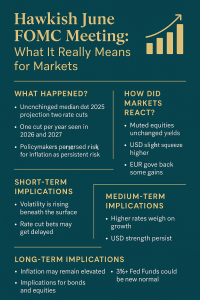
Hawkish June FOMC Meeting: What It Really Means for Markets
Meta description: The hawkish June FOMC meeting surprised markets with inflation concerns and reduced rate cuts. What does it mean for investors in the short, medium, and long term?
The Federal Reserve just reminded markets who’s boss. Despite hopes for rate cuts, the June FOMC meeting came in hawkish—a warning shot to those betting on an easy money pivot. While the 2025 dot plot still reflects two rate cuts, deeper inside the Summary of Economic Projections (SEP), it’s clear the Fed is worried inflation might stick around longer than we’d like—especially with tariffs creeping higher.
So why didn’t markets react more? Why did stocks stay mostly flat, and bond yields barely flinch? And what does it all mean for the U.S. dollar, global currencies, and your portfolio?
What Actually Happened at the June FOMC Meeting?
- The Fed kept its 2025 projection for two rate cuts.
- For 2026 and 2027, they now expect just one cut per year, not two—hinting at higher‑for‑longer interest rates.
- Jerome Powell emphasized that inflation risks haven’t gone away, especially with higher tariffs feeding into costs.
- Despite calm recent inflation data, the Fed doesn’t trust it. Powell warned inflation may accelerate again soon, though labor markets remain stable.
This wasn’t a “nothingburger”—it was a hawkish pause, a shot across the bow to markets too eager to celebrate.
How Markets Reacted (Or Didn’t)
- Equities stayed largely flat—cautious, not panicked.
- U.S. Treasury yields remained near unchanged, likely due to low positioning ahead of the meeting.
- USD edged higher, reflecting Powell’s hawkish tone.
- EUR/USD sits around 1.1450–1.1500.
- USD/JPY holds in the 144.50–145.50 range, with upside potential toward 146.
- AUD/USD remains range‑bound in mid‑0.65s, pressured by geopolitical risks.
- AUD/NZD looks strong, backed by New Zealand’s softer economic data.
Markets are now eyeing:
- SNB decision (June 19 at 3:30 pm) — expected 25 bps cut (possibly 50).
- BoE decision (June 19 at 7:00 pm) — likely cautious despite hot May CPI.
Short‑Term Implications: Volatility Without Panic
- Markets may stay calm on the surface, but underlying volatility is rising.
- Rate‑sensitive assets (tech stocks, long‑duration bonds) may wobble.
- Currency traders should expect tighter ranges and sudden breakouts, especially in USD/JPY and AUD pairs.
- Gold and Bitcoin might firm up as inflation hedges.
- Different inflation outcomes → delayed rate cuts → stronger USD and pressure on emerging markets.
Medium‑Term Implications: Repricing of Expectations
- High borrowing costs may slow corporate buybacks, capex, and eventually employment.
- Consumers will face higher mortgage and credit costs.
- USD strength could persist—especially versus EUR and NZD.
- If 2025 cuts don’t materialize, growth may slow but labor can hold—expect a “slow‑burn grind.”
Long‑Term Implications: A New Economic Regime?
- De‑globalization, tariffs, and reshoring suggest structurally higher inflation.
- Zero‑rate QE days may be behind us—3 %+ Fed Funds might become the new norm.
- Portfolios may need to adjust:
- Bonds may lose diversification edge—60/40 portfolios could struggle.
- Growth equity valuations may reset lower.
- Alternative assets (commodities, private credit, real assets) could outperform.
We might be entering a post‑disinflation world where inflation control outweighs growth management.
Final Thoughts: What Should You Do?
This June FOMC meeting may not have rattled markets, but it was a clear warning: the Fed isn’t ready to declare victory on inflation. It’s time to adjust expectations and your investment playbook.
- Don’t fight the Fed—but prepare for slower, fewer cuts than markets hope.
- Stay nimble and diversified—balance between growth, income, and inflation‑resilient assets.
- Stay informed: track inflation data, Fed communication, and global economic shifts.
