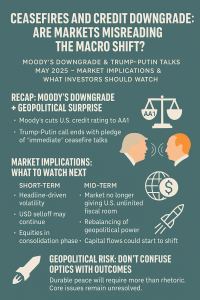
Moody’s Downgrade & Trump-Putin Talks May 2025 — Market Implications & What Investors Should Watch
Markets showed remarkable composure this week. Despite Moody’s downgrade of the U.S. credit rating to AA1 and headline-grabbing peace talk signals between Trump and Putin, U.S. equities reversed losses, Treasuries rallied, and volatility remained contained. But beneath the surface, the global macro narrative is shifting — and fast.
Investors need to look beyond the price action and assess whether we’re witnessing short-term noise or a structural turning point in U.S. fiscal credibility, global risk perception, and geopolitical alliances.
Recap: Moody’s Downgrade + Geopolitical Surprise
- Moody’s credit rating downgrade to AA1 brings all three major agencies in alignment — a symbolic blow to U.S. fiscal dominance.
- The Trump-Putin call, clocking in at over 2 hours, ended with public commitments to “immediate” ceasefire talks in Ukraine, though no framework was agreed.
- Treasuries caught a bid, with 30-year yields briefly topping 5% before retreating.
- The U.S. dollar weakened further (BBDXY -1.4%), while equities and commodities stabilized.
Market Implications: What to Watch Next
- Short-Term: Repricing May Be Shallow But Volatile
- Expect headline-driven volatility. Market reactions are becoming more sensitive to geopolitical rhetoric and central bank nuance.
- The USD selloff may continue as investors digest de-dollarisation headlines, recent rate guidance, and a possible shift in safe-haven preference.
- Equities are likely to remain in a consolidation phase, with upside capped by earnings uncertainty and downside cushioned by geopolitical optimism.
- Mid-Term: Structural Realignment Underway
- The triple downgrade signals a deeper concern: the market is no longer giving the U.S. unlimited fiscal room. This will raise the stakes for debt ceiling debates, tax policy, and spending plans.
- If Trump’s diplomatic style gains traction, expect a rebalancing of geopolitical power that may favor bilateral trade, regional alliances, and reduced U.S. leverage in global institutions.
- Capital flows could start to shift, especially if safe-haven capital migrates toward gold, commodities, and more fiscally disciplined G10 countries.
FX & Commodities Outlook
- EUR/USD: Still favored on dips (support: 1.1180; resistance: 1.1420/1.16). De-dollarisation talk and EU coordination add upside pressure.
- USD/JPY: Trading in 142–150 range. Treasuries’ rally lends support, but the broader USD narrative weighs. Two-way interest seen.
- AUD/USD: Hawkish RBA tone expected today. Buy dips (support: 0.6350; resistance: 0.6690).
- Gold: Rebounded off 3202. Watch for bullish breakouts if USD weakness continues and geopolitical hedging returns.
Geopolitical Risk: Don’t Confuse Optics with Outcomes
The Trump-Putin call was rich in theatrics but light on substance. While a peace process is welcomed, the core issues — NATO, territorial concessions, and trust — remain unresolved.
Markets may have overreacted to the optimism. The risk of a geopolitical whipsaw remains high, and any breakdown in diplomacy could trigger renewed selling in risk assets and another bid for hard assets like gold and JPY.
Investor Strategy: What to Do Now
In the short term (1–3 weeks):
- Stay nimble: Trade ranges, not breakouts. We are still in a reactive, headline-driven market regime.
- Watch USD carefully: A deeper decline in the dollar could boost EM assets and commodity-linked FX.
- Favor real assets: Gold, oil, and defensive equities offer asymmetrical upside in a world of policy drift.
In the medium term (1–3 months):
- Reassess USD allocations: Moody’s downgrade may be symbolic, but the narrative shift matters.
- Look for regional winners: Countries with fiscal discipline, political cohesion, and commodity leverage (e.g., Australia, Canada) could outperform.
- Position for volatility: Buy downside protection in equities and monitor yield curves for steepening risk.
Conclusion: Calm on the Surface, Pressure Beneath
Markets appear resilient. But beneath the surface, fiscal, geopolitical, and monetary forces are converging in ways that could redefine global capital allocation. The Moody’s US credit downgrade and Trump-Putin peace headlines may seem disconnected — but both reflect the same thing: a world shifting away from old assumptions.
This is not the end of U.S. dominance — but it may be the end of taking it for granted.
Read more on Moody’s downgrade
