May 2025 | Global Insight on U.S. Global Leadership
Global leadership doesn’t end with a bang. It erodes in stages — through mismanaged debts, broken domestic trust, fraying alliances, and a rising competitor that moves with greater clarity. That’s the world we are stepping into now.
Amid headline-grabbing trade deals and diplomatic tours, deeper currents are shifting. America still wears the crown, but the world is already behaving as if the coronation of the next superpower is under way. The question is no longer if the U.S.-China balance is changing. The real question is: Who adapts better to a more fractured, volatile world — and what does it mean for your money?
America: Still the Deepest Well, But Cracking at the Edges
The United States remains the most investable market in the world. Its capital markets are liquid, its legal framework is (mostly) stable, and its tech ecosystem continues to produce world-changing innovation. On paper, it still leads.
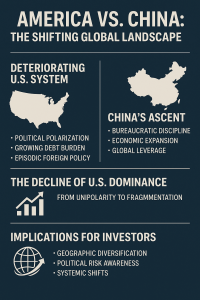
But under the surface, the fractures are widening. Political polarization is not just a headline — it’s a structural liability. The government is trapped between the need to borrow more and the shrinking global appetite to buy that debt. As fiscal management becomes more theatrical than rational, trust in U.S. policy is eroding.
Trump’s second administration is betting on a transactional foreign policy, aggressive capital repatriation, and regulatory rollback. That may produce short-term wins. But it’s unlikely to resolve long-term decay unless it’s paired with genuine institutional repair and domestic unity — neither of which are in clear view.
China: Not the Alternative, But the Ascent
China doesn’t need to overtake the U.S. in GDP to reshape U.S. global leadership. It already commands influence through trade corridors, digital infrastructure, and geopolitical leverage. Its approach — discipline at home, bilateral incentives abroad — appeals to governments fatigued by the Western lecture model.
Yet China is far from invincible. Its demographic decline, credit overhang, and internal control mechanisms limit dynamism. But Beijing plays the long game, and it does so with fewer constraints from public opinion, elections, or dissent. That gives it an edge in an era defined by speed, data, and industrial control.
The Transition Nobody Is Prepared For
We are not witnessing the rise of a new empire. We are watching the fragmentation of U.S. global leadership.
Global trade no longer runs on shared rules. Investment capital no longer flows to the “freest” markets — it flows to the most stable ones. Alliances are fluid. Technology is split across firewalled ecosystems. Countries are reshoring, weaponizing supply chains, and prioritizing survival over globalism.
The world is not turning Chinese or reverting to American dominance. It is splintering — and that creates a future where no one calls the shots, and influence is local, transactional, and short-lived.
So What Does This Mean for Investors?
Geography matters more than ever. Investing is no longer about finding the next sector winner — it’s about understanding which political and economic systems are most resilient.
Liquidity isn’t security. U.S. assets may remain liquid, but liquidity is not a substitute for policy consistency. Watch Washington as closely as you do earnings reports.
Diversify across systems, not just sectors. One exposure to tech in the U.S. is not the same as exposure to tech in Southeast Asia or Europe. You need both.
Follow control, not narratives. Countries that control energy, data, and infrastructure — and can defend it — will outperform.
This is not a normal cycle. Stop expecting it to behave like one.
Final Thought on U.S. Global Leadership
The world is not collapsing. But the model we’ve known — unipolar, dollar-dominant, rules-based — is. What replaces it may be more competitive, more volatile, and more regionalized.
In that world, investors will need more than conviction. They will need clarity.
The U.S. still has a chance to lead. But leadership now requires more than muscle. It demands vision, discipline, and trust. And those are harder to negotiate than trade deals.
For related insights, visit our full blog archive.
