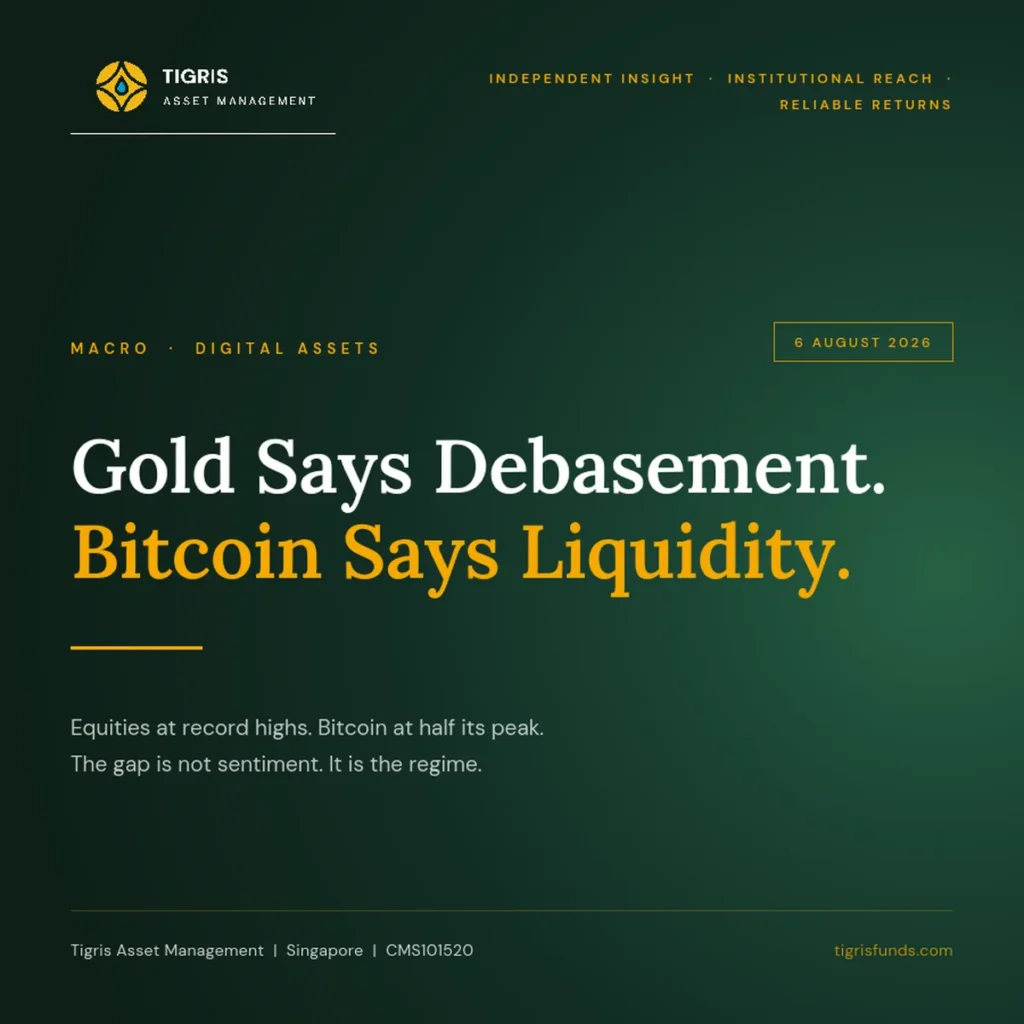
Share markets are at record highs. Bitcoin is worth roughly half what it was last October. The reason is not that people have gone off crypto. It is that money has stopped being cheap, and expensive money punishes anything that pays you nothing while you hold it.
That is the whole argument in three sentences. Professionals call this gap the bitcoin equity divergence. The rest of this piece explains it without the jargon, and sets out what it means if you own either.
What actually happened
| Asset | Where it is | In plain terms |
|---|---|---|
| S&P 500 (US shares) | 7,736 | A record high on 4 August. The best it has ever been. |
| Bitcoin | About $64,600 | Roughly half its October 2025 peak of $126,080. |
| Gold | About $4,200 an ounce | Up around 24% over the past twelve months. |
| US interest rate | 3.50% to 3.75% | Held steady. Three officials voted to raise it. |
| US government borrowing cost (10 years) | About 4.62% | Close to an 18-month high. |
Two things stand out.
Bitcoin has been falling for ten months, not ten days. This is not a wobble.
And gold, which is supposed to do the same job as bitcoin, has gone the other way entirely.
First, the one thing that explains most of it
Interest rates.
When a central bank keeps interest rates low, money is cheap. People borrow, take more risk, and happily hold things that pay nothing today in the hope of a payoff later.
When rates are high, that changes. Today you can earn more than 4% a year simply by lending money to the US government, with almost no risk of losing it. That is now the bar. Everything else has to beat it.
The US Federal Reserve has held its rate at 3.50% to 3.75% for the fifth meeting running. At the July 2026 meeting, three of its officials voted to raise rates. Not cut. Raise.
So every investor is quietly asking the same question. Why would I hold something risky that pays me nothing, when something safe pays me over 4%?
Bitcoin has no good answer to that question.
Why shares coped and bitcoin did not
Think of a share as owning a small slice of a working business. The business sells things to customers. When prices rise, it can charge more. It earns real money, and some of that money eventually comes back to you.
Now think about bitcoin. It sells nothing. It earns nothing. It has no customers and no revenue. Its entire value is whatever the next person is willing to pay for it.
Higher interest rates hurt both. But shares have something to fight back with.
In early August, the big technology companies reported strong profits and spending on artificial intelligence picked up again. Those are real earnings, and they rose faster than borrowing costs did. That is why shares reached records in a month when interest rates were still uncomfortably high.
Bitcoin has nothing to fight back with. There is no earnings figure to put on the other side of the scale. That is the whole difference, and it is simpler than most explanations make it sound.
Why gold went up while bitcoin went down
This is the part most commentary skips, and it is the most revealing.
Bitcoin has been sold to professional investors for years as “digital gold”. The pitch is easy to follow. The supply is fixed. No government can print more of it. So when governments let inflation erode the value of ordinary money, bitcoin should protect you.
That claim now has a test result.
US inflation has been above the Federal Reserve’s 2% target for more than five years. The erosion of money is not a theory here. It is happening, and it has been happening for a long time.
Real gold is up around 24% over twelve months. Bitcoin is down about 49% from its peak.
If bitcoin were digital gold, this is precisely the weather it was built for. It did not work.
The two-hedge contradiction
Here is the clearest way we have found to understand what is going on. We have given it a name, because the market keeps talking around it.
Bitcoin has been sold as two different things at the same time.
The first pitch: it protects you when money loses value. That is an umbrella. You want it when it rains.
The second pitch: it rises faster than everything else when markets are booming. That is a surfboard. You want it when conditions are good.
An umbrella and a surfboard are not the same object. They are not useful in the same weather.
For four years, from 2020 to 2024, interest rates were very low and money was very cheap. It was raining and the surf was up at once. Nobody had to work out which item they had actually bought.
2026 has forced the question. Inflation is high, which is umbrella weather. But money is expensive, which is poor surfing weather.
Gold, a genuine umbrella, went up. Bitcoin went down.
We call this the two-hedge contradiction. Bitcoin was never both things. This is the year the market found out which one it is, and the answer looks like the surfboard.
That is our interpretation rather than a proven fact. But it is one you can test, which is more than can be said for most arguments about crypto.
What the bitcoin equity divergence is really telling you
Two common readings are wrong, and it is worth saying why.
“Everything is going up except crypto.” Not quite. The Nasdaq is still about 2% below its June high. And part of the reason shares rose was that oil fell roughly 10% in a single week, which brings inflation down. That is not investors suddenly becoming braver across the board. It is a specific piece of good news for companies that earn money.
“Holders will simply sit tight.” Some will. But bitcoin has a different kind of owner now. Exchange-traded funds brought in professional wealth managers who bought it because they were told it would protect a portfolio. Those people answer to committees and follow written rules. When the stated reason for owning something stops being true, they sell for procedural reasons rather than emotional ones. That is slower selling. It is also far more persistent, and it does not show up in the crypto data most people watch.
What this means if you are an investor
Three practical points.
One: check whether it did the job you bought it for. If you hold bitcoin as protection against inflation, look at the past twelve months. It did not protect you. That is a reason to revisit how much you hold, and it is a separate question from whether you think the price recovers.
Two: the conditions that hurt bitcoin help lending. When interest rates are high, loans pay more interest. Private credit, which simply means lending money directly to companies instead of buying their shares, earns a higher income in exactly this environment. That shapes how we think about our fund strategies and how they sit alongside listed investments in a managed portfolio.
Three: but check the money is actually arriving. High rates squeeze borrowers too. Some companies are quietly renegotiating their loans so they can delay paying interest rather than default outright. We have written about this at length in Tigris Insights. The same scepticism cuts both ways. Be wary of an asset that pays you nothing, and equally wary of one that promises to pay you but keeps postponing.
Where this argument could be wrong
It is worth being honest about the weak points.
Bitcoin has not lived through many cycles. It has existed through roughly one and a half periods of rising interest rates. That is not enough history to draw a firm rule from, and anyone claiming certainty here is overreaching.
The fall may be about crowding rather than principle. Bitcoin’s October 2025 peak came with heavy borrowing and record inflows into funds. Crowded trades overshoot on the way down as a matter of routine. A 49% fall is exactly what that looks like, and it would tell you nothing lasting about the asset.
Some of it is simply bad luck. There have been fund outflows and a wallet security incident in recent weeks. Not every price move is about interest rates.
Our own argument predicts a rally. If bitcoin is the surfboard, it should rise sharply the moment rates start falling. If that happens, it confirms our reading rather than disproving it. Do not mistake a rebound for a refutation.
What to watch next
Not the price. The reaction.
Watch what bitcoin does the next time an inflation figure comes in higher than expected. A genuine inflation hedge rises on that news. A risk asset falls, because higher inflation means higher rates for longer. Gold and bitcoin should move in opposite directions on the same headline. Through 2026, they mostly have, and that single observation is doing more work here than any price chart.
Then watch what happens when rates finally look like falling. If bitcoin jumps first and hardest, the surfboard reading is settled.
Either way, the question worth holding on to is not whether bitcoin is cheap. It is what job you are asking it to do, and whether ten months of evidence suggests it can do that job.
Frequently asked questions
Why is bitcoin falling while share markets hit record highs?
Because the two respond to different things. Shares rose on strong company profits, particularly from technology firms spending on artificial intelligence, helped by a fall in oil prices. Bitcoin has no profits to report. That leaves it fully exposed to high interest rates, currently 3.50% to 3.75% in the US, with some officials still pushing to raise them.
Is bitcoin still a hedge against inflation?
The evidence of the past year does not support that. US inflation has been above target for more than five years. Over twelve months gold is up around 24% and bitcoin is down about 49% from its peak. An asset that falls while the very condition it is meant to protect against is present is not working as protection. Whether it behaves differently in a future environment is an open question.
What is the two-hedge contradiction?
It is our term for the fact that bitcoin has been marketed as two incompatible things at once: protection against money losing value, and an asset that soars when markets boom. Those two roles need opposite conditions. Between 2020 and 2024, cheap money satisfied both at the same time, so nobody had to choose. High inflation combined with expensive money has now separated them, and bitcoin has behaved like the second, not the first.
Does this mean bitcoin is cheap now?
Not necessarily, and it may be the wrong question. A divergence tells you that two assets are responding to different forces. It does not tell you that either one is mispriced. If bitcoin moves with the availability of cheap money, then today’s price is a reasonable response to today’s conditions rather than a bargain waiting to be picked up.
If not bitcoin, what tends to do well when interest rates are high?
Broadly, things that pay you a contracted income which rises with rates. Lending is the clearest example, including senior secured private credit, where the loan sits first in line for repayment. The catch is that high rates also squeeze the companies doing the borrowing, so the discipline is to check that the interest is genuinely being paid in cash rather than deferred. You can discuss how this applies to your own portfolio through the Tigris contact page.
This material is for informational purposes only and does not constitute an offer or solicitation to buy or sell any investment product. Market data cited is as at 5 to 6 August 2026 and is subject to change. Past performance is not indicative of future results. Investment products are available only to accredited and institutional investors as defined under the Securities and Futures Act 2001 of Singapore. Tigris Asset Management Pte Ltd holds Capital Markets Services Licence CMS101520 issued by the Monetary Authority of Singapore.
