Asia private credit
Asia private credit fundraising has collapsed to its weakest level in more than a decade, but a fall in capital raised is not evidence that borrower demand or lending opportunity has disappeared. The data measures how much money managers attracted, not how much financing Asian businesses need. Those are different questions, and conflating them produces the wrong allocation decision.
What the fundraising data actually shows
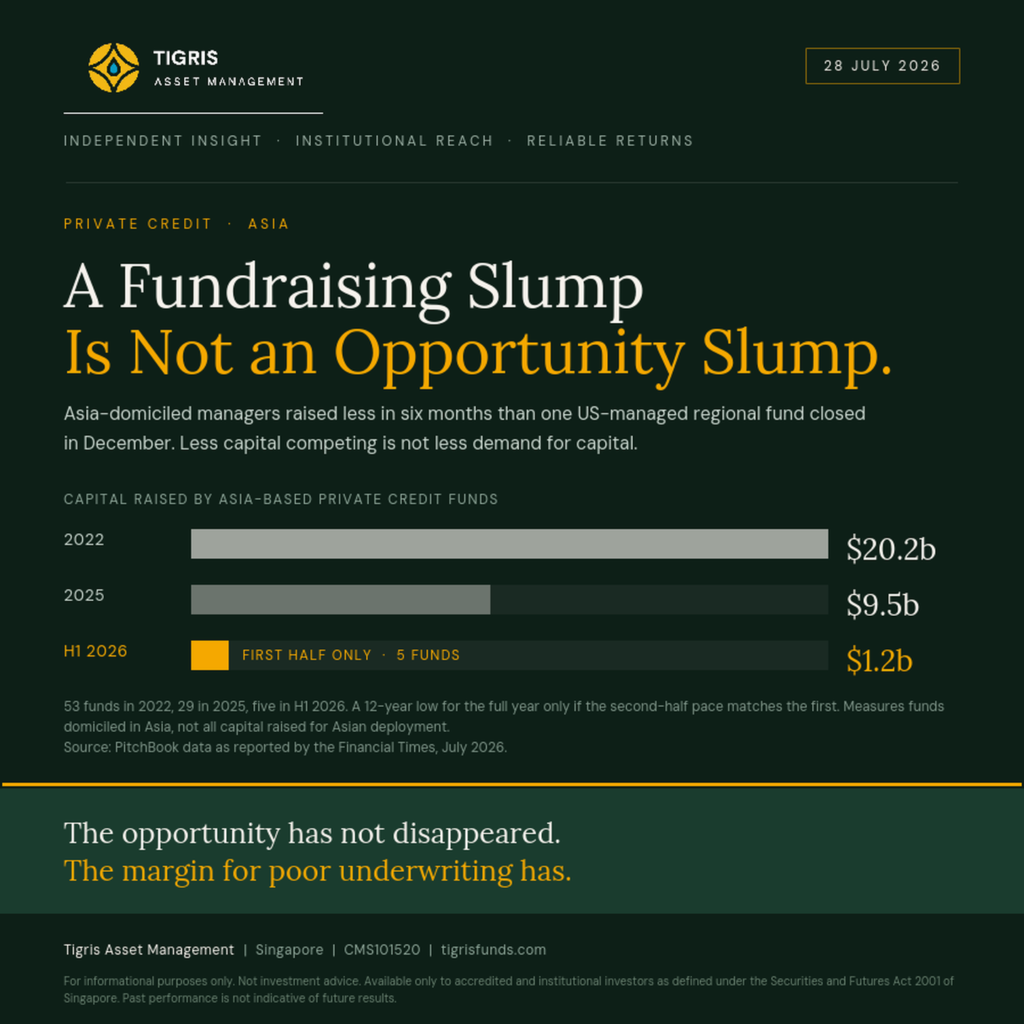
Five private credit funds based in Asia closed in the first half of 2026, raising a combined $1.2bn. That compares with 29 funds raising $9.5bn across 2025, and 53 funds raising $20.2bn in 2022. The figures come from PitchBook data reported by the Financial Times on 27 July 2026, and Tigris has not been able to verify them against the primary PitchBook release.
Three qualifications matter before the number is used to draw a conclusion.
The “12-year low” is a projection, not a result. It applies to the full year 2026 only if the second-half pace matches the first. Six months of fundraising data in an asset class where a single fund close can move the annual total by 20% is a thin basis for a structural verdict.
The measurement is manager domicile, not regional exposure. These are funds based in Asia. Capital raised by US and European managers for Asia-Pacific deployment sits outside the count. KKR closed an Asia-Pacific credit vehicle with $2.5bn of total investable capital in December 2025, a single fund larger than the entire first-half figure for Asia-domiciled managers. The headline therefore describes a shift in who is trusted to hold the capital, not a withdrawal of capital from the region.
The direction of institutional intent runs the other way. Temasek has said it intends to raise its private credit allocation from 2% to 5% by 2031. The Alternative Investment Management Association forecast in November 2025 that Asia-Pacific private credit assets could grow 46% to $92bn between 2024 and 2027. That is a forecast, not a fact, and forecasts made before a redemption cycle deserve scepticism. But it is difficult to reconcile a genuine collapse in opportunity with sovereign investors publishing plans to more than double their weighting.
Why fundraising sentiment is not borrower demand
Fundraising measures the confidence of limited partners. Borrower demand measures the financing gap left by banks. In Asia the two have never been tightly coupled, and they are decoupling further.
The reported driver of the slowdown is investor caution following corporate defaults and high-profile bankruptcies, most of which occurred in the United States rather than Asia. First Brands and Tricolor were American filings. The software valuation pressure that has unsettled direct lending portfolios is concentrated in North American technology credit. Asian allocators are pulling back from Asian managers partly in response to losses recorded elsewhere.
That is a sentiment transmission, not a credit assessment. It tells you something real about the price of capital for a first-time Asian manager. It tells you almost nothing about whether a cash-generative Korean industrial or an Indian infrastructure developer still needs senior secured financing that its bank will not provide.
The structural conditions that created Asian private credit remain in place: bank capital rules that penalise mid-market corporate lending, thin high-yield bond markets outside Japan and Australia, and a large population of family-controlled businesses that will not accept the governance conditions attached to equity. None of those has changed since 2022, when 53 funds raised $20.2bn against the same underlying demand.
Can scarcer capital improve lending discipline?
Yes, in a specific and measurable way. Lending terms are set by competition between lenders, not by the level of policy rates.
When 53 funds were competing in 2022, the marginal deal was won by the lender willing to accept the loosest documentation. Covenant packages thinned, leverage crept upward, and information rights were negotiated away. When five funds close in six months, the borrower’s alternatives narrow and the negotiating position inverts. The lender with committed capital can hold the line on maintenance covenants, security perfection, cash sweep mechanics and information undertakings.
This is the part of the cycle where good loans are written. It is also uncomfortable, because it coincides with the period when raising a fund is hardest and when the previous vintage is showing its weakest marks. The managers who benefit are those who already have capital and do not need to be in the market for it.
The caution is that scarcer capital improves terms only for lenders with the discipline to demand them. A constrained market also produces adverse selection: borrowers who cannot access bank credit or the syndicated market for good reason arrive first. Less competition raises the ceiling on achievable terms. It does not raise the floor on borrower quality.
Why headline yield is the wrong starting point
The industry narrative of the past four years held that private credit works because rates are high. That proposition is now being tested, and it was always analytically weak.
The US bond market is not positioned for a directional rate move. Reuters reported on 28 July 2026 that investors expect the Federal Reserve to hold at 3.50% to 3.75%, with June consumer inflation at 3.5%, energy prices rising and portfolio managers explicitly avoiding large duration or credit bets. Fitch recorded a US private credit default rate of 6.0% for the twelve months to May 2026, the highest since its series began in August 2024, and noted that much of the stress is appearing through maturity extensions, payment deferrals and the introduction of PIK interest rather than through uncured payment defaults. (The Fitch figure is drawn from second-hand market commentary rather than the Fitch release itself.)
Read those two facts together. Base rates are stable and may fall. Credit stress is rising and is partly being deferred rather than resolved. A strategy whose return depends on the base rate staying high is exposed on both sides of that trade.
The questions that actually determine outcomes are narrower and duller:
- How will the loan be repaid? Not “what is the exit multiple assumption” but which cash flows, on what schedule, from which entity, under which currency.
- What can the lender control if repayment is delayed? Which covenant triggers first, how quickly, and what does triggering it actually entitle the lender to do in the borrower’s jurisdiction.
- What is the collateral genuinely worth under stress? Not the appraisal, but the realisable value net of enforcement time, legal cost and the discount a forced sale imposes.
The third question is where Asia diverges sharply from the US and Europe. Legal commentary on the first half of 2026 has flagged that enforcement in Asia is complicated by fragmented legal regimes, uneven enforcement outcomes and a high proportion of family-owned borrowers. A security package that would be decisive in a New York proceeding may be substantially less effective in practice across several Asian jurisdictions. Documentation quality compounds this: much private credit paper has not yet been tested through litigation, and the gaps tend to become visible only when something has already gone wrong.
That is not an argument against Asian private credit. It is an argument that the underwriting premium in Asia is earned in the documentation and the security structure, not in the coupon.
The next phase belongs to selective lenders
Private credit has been distributed to a substantial part of the market as a passive high-yield allocation: a spread over base rates, delivered by a manager, requiring no engagement. The retail redemption pressure now visible in listed and semi-liquid vehicles is the predictable consequence of selling an illiquid, workout-intensive asset into a wrapper that promised liquidity.
Moody’s noted in July 2026 that Asia-Pacific private credit fundraising and deployment growth is likely to slow over the next twelve to eighteen months, and that redemption requests across the global market have intensified scrutiny of liquidity terms, particularly in retail and wealth channels. The Financial Times reporting makes the same observation from the other side: institutional investors continue to commit, in part to access opportunities created by the retreat of retail capital.
This is the genuine structural shift. Not a contraction of the asset class, but a change in who holds it and on what terms. Capital raised from investors who understand a five to seven year lock-up behaves differently in a workout from capital raised through a monthly-liquidity wealth platform. The first can restructure a loan on its merits. The second is under pressure to mark, sell or gate.
What this means for allocator positioning
Four practical implications follow.
- Separate manager risk from asset risk. The fundraising data is primarily evidence about manager selection, not about Asian credit fundamentals. An allocator should read it as a signal that the LP base has become more discriminating, which is not the same as a signal to reduce exposure.
- Underwrite the wrapper alongside the loans. A portfolio of sound senior secured Asian loans inside a vehicle with a liquidity mismatch is a different risk from the same loans inside a closed-end structure. The wrapper determines whether the manager can hold through a workout or is forced to transact.
- Ask for the enforcement history, not the default rate. In a market where stress is being expressed through extensions, deferrals and PIK conversion, the reported default rate has become a narrow measure. Ask instead what proportion of the portfolio has been amended, how many amendments extended maturity, and what the manager recovered in the situations that went to enforcement.
- Treat capital scarcity as a term-setting opportunity, with discipline. Better terms are available to lenders who can deploy now. Adverse selection is also strongest now. Those two facts are not in conflict, and both should be priced.
Frequently asked questions
Has Asian private credit fundraising really hit a 12-year low? The first half of 2026 was the weakest half in more than a decade for Asia-domiciled managers, with five funds raising $1.2bn according to PitchBook data reported by the Financial Times. Whether the full year sets a 12-year low depends on second-half activity, which has not yet occurred.
Does falling fundraising mean Asian private credit returns will fall? Not necessarily, and the relationship may run in the opposite direction. Fewer competing lenders generally improves pricing, covenant packages and security for lenders who still have capital to deploy. The risk is not lower returns but adverse selection in the borrowers that reach a constrained market first.
Why are investors favouring large US managers over Asian managers? Reported caution follows corporate defaults and bankruptcies concentrated in the United States, alongside a general preference among limited partners for managers with scale and long track records during periods of stress. This reflects allocator behaviour rather than a specific assessment of Asian credit quality.
What is the main risk in Asian private credit that US-focused analysis misses? Enforcement. Fragmented legal regimes, uneven enforcement outcomes and a high proportion of family-controlled borrowers mean that a security package may be materially less effective in practice than its documentation suggests. Collateral value in Asia should be assessed net of enforcement time and cost, not at appraisal.
Is private credit still attractive if interest rates fall? The return of a well-underwritten senior secured loan depends on repayment, control and collateral, with the base rate as one input among several. Strategies whose economics depend primarily on the base rate remaining elevated are the ones exposed to a rate decline.
The opportunity in Asian private credit has not disappeared. The margin for poor underwriting has.
Tigris Asset Management Pte Ltd holds Capital Markets Services Licence CMS101520 issued by the Monetary Authority of Singapore. This material is for informational purposes only and does not constitute an offer or solicitation to buy or sell any investment product. Past performance is not indicative of future results. Investment products are available only to accredited and institutional investors as defined under the Securities and Futures Act 2001 of Singapore.
