The Fear, Stated Plainly
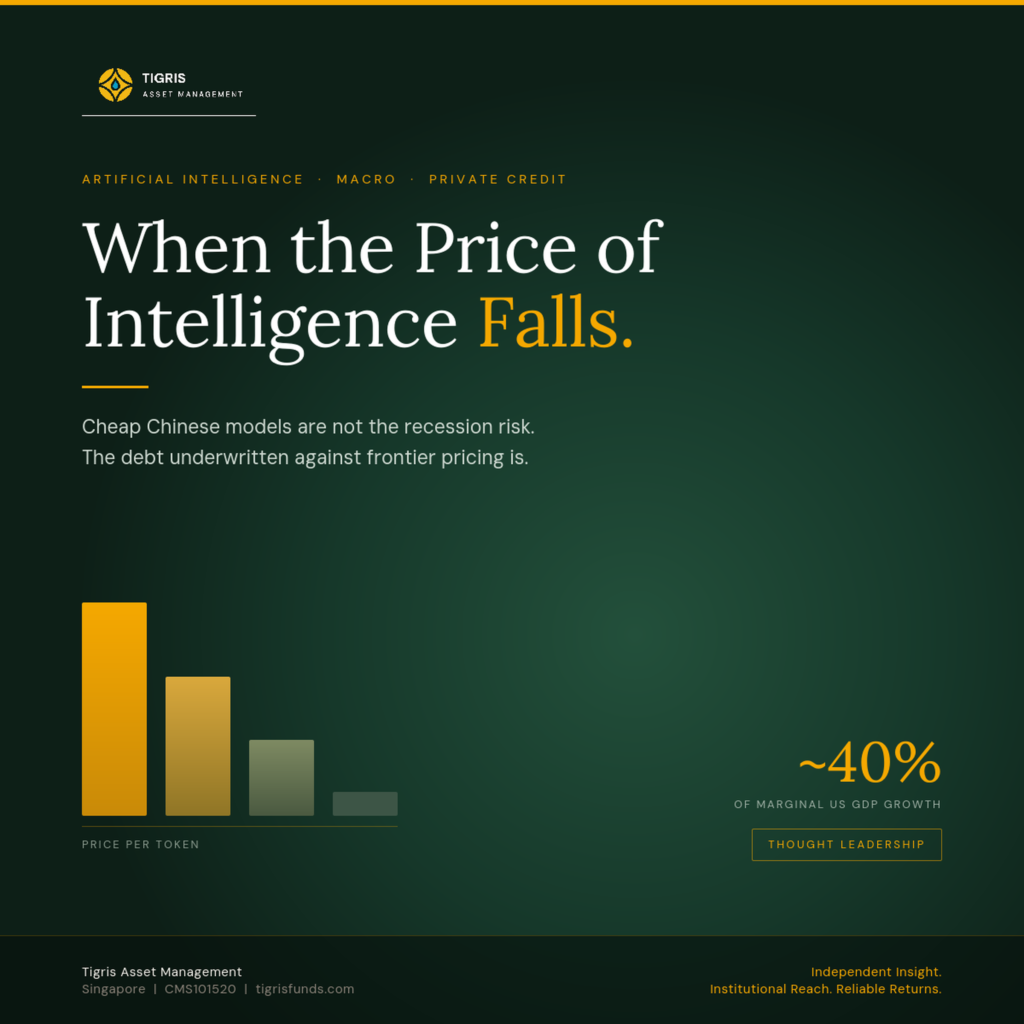
Cheap open-weight Chinese AI models are unlikely to cause a US recession by destroying subscription revenue. That channel is too small. The genuine risk is narrower and less discussed: if the market revises downward its expected return on AI infrastructure, the financing that funds roughly 40% of marginal US GDP growth could withdraw faster than the physical buildout can slow. The transmission mechanism is credit, not software pricing.
The argument circulating among allocators runs something like this. Chinese labs — DeepSeek, Moonshot, Alibaba’s Qwen, Zhipu — release capable models with open weights at a fraction of Western prices. Enterprises defect. OpenAI and Anthropic revenue assumptions collapse. Hyperscaler capex, which has been carrying the US economy, gets cut. Growth, which depends on that capex to an uncomfortable degree, goes with it.
It is a clean story. Clean stories about markets usually contain one true premise and one broken joint.
The true premise is the macro dependency. Estimates from the Federal Reserve Bank of St. Louis put AI-related investment at roughly 39% of marginal US real GDP growth over the four quarters to early 2026. That is a share of growth, not of output: AI data-centre investment itself is closer to 0.8% of GDP by Epoch AI’s Q1 2026 measure. But the growth share is what matters cyclically. Remove it and the arithmetic of an expansion becomes considerably less comfortable.
The broken joint is the pricing claim.
What the Price Gap Actually Looks Like
Precision matters here, because the narrative has run ahead of the numbers.
Moonshot’s Kimi K3, released mid-July 2026, delivers near-frontier capability at roughly $15 per million output tokens, against approximately $25 to $30 for Claude Opus and GPT-5.6. That is a discount of 1.5 to 2 times. Meaningful. Not a collapse.
At the commodity end the gap is far wider. DeepSeek V4 Flash lists at $0.14 input and $0.28 output per million tokens, MIT-licensed, with a one-million-token context. Against GPT-5.6 output pricing, that is a differential of more than fifty times. But V4 Flash scores 79.0% on SWE-bench Verified against 88.6% for Claude Opus 4.8. The gap in price is enormous. The gap in capability at the hardest tasks is not zero.
This produces a specific market structure rather than a general collapse. Sophisticated buyers arbitrage: route the high-volume, quality-tolerant work to open weights, keep a frontier model for the tasks where the last ten points of capability carry commercial consequence. Reports in June 2026 that OpenAI was weighing significant token price reductions suggest the incumbents read this the same way.
So the first-order conclusion is not that subscriptions become unjustifiable. It is that the margin on undifferentiated inference goes to approximately zero, and the frontier labs are pushed into a narrower, more defensible, and much smaller high-value tier.
That is a serious commercial problem. It is not, by itself, a recession.
The Question Almost Nobody Asks Correctly
Here is where the analysis usually goes wrong, and where it gets interesting.
The instinctive assumption is that cheaper AI means less compute demand, therefore less capex, therefore less GDP. The history of the last eighteen months argues against it. When DeepSeek’s R1 triggered the January 2025 selloff that erased close to $600bn of Nvidia market value in a single session, the consensus prediction was capex retrenchment. Instead AI spending accelerated through 2025. Cheaper capable models expanded the addressable market for inference rather than shrinking it. Satya Nadella’s invocation of the Jevons paradox looked opportunistic at the time. It looked correct twelve months later.
If that dynamic holds, cheap Chinese models are bullish for aggregate compute demand and therefore neutral-to-positive for the GDP contribution, even as they are bearish for Western lab margins.
Which raises the question worth actually holding: if the physical demand for compute is robust to price collapse, what exactly would break?
The Answer Is in the Capital Structure
The AI buildout stopped being funded out of operating cash flow some time ago.
AI-related companies tapped debt markets for at least $200bn in 2025. Morgan Stanley projects $250bn to $300bn of hyperscaler issuance alone in 2026. Technology companies have moved more than $120bn of data-centre spending off balance sheet in roughly eighteen months through special purpose vehicles: Meta’s $27bn Hyperion transaction with Blue Owl, a $38bn debt package across two Texas and Wisconsin sites, an $18bn New Mexico facility. Private credit lending to AI-related companies grew from around $3bn in 2010 to over $40bn of originations in 2025, per BIS Bulletin No. 120, with Morgan Stanley projecting a further $800bn of data-centre financing from private credit over two years.
The Bank for International Settlements named this explicitly in its June 2026 Annual Economic Report, identifying an AI capex bust alongside circular financing and sovereign debt fragility as the three interlocking pressure points most likely to fracture global financial stability. The BIS language is worth reading precisely: disappointment in returns could trigger a sudden pullback in financing and turn the capex boom into a protracted investment bust.
That sentence contains the actual mechanism. Not “cheaper models reduce demand.” Rather: cheaper models reduce the credibility of the revenue projections against which the debt was underwritten.
Those are different failures with different speeds.
Why the Financing Channel Moves Faster Than the Physical One
A data centre under construction has enormous inertia. Contracts are signed, land is banked, power interconnection queues are years deep. Physical capex does not stop quickly.
Credit stops instantly.
This is the asymmetry that deserves attention. Consider the structure honestly. Data-centre securitisation is projected at $30bn to $40bn annually across 2026 and 2027, reaching 7% to 10% of combined ABS and CMBS issuance. The ABS market at roughly $25bn faces projected take-out needs approaching $300bn. GPU lifecycles of around seven years sit awkwardly against real estate financing tenors. Sub-investment-grade neocloud tenants have entered a market that was underwritten on hyperscaler credit quality.
Now introduce a repricing event. Not a collapse in compute demand, merely a downward revision in the price per token that the eventual revenue will command. Debt service coverage assumptions built on frontier pricing get tested against commodity pricing. The assets are still useful. The cash flows they were financed against are smaller than modelled.
The equity holder absorbs this slowly. The credit market absorbs it in a repricing window measured in weeks.
Who Bears the Risk, and Who Thinks They Do Not
The distribution here is worth being specific about, because it is not where casual reading would place it.
The hyperscalers are the least exposed. They have balance sheets, diversified revenue, and the option to slow spending. Corporate bond investors take comfort in their blue-chip status, and that comfort is largely earned.
The frontier labs bear the margin risk but are, in macro terms, small.
Private credit bears the concentrated risk, and does so with the structural features that make stress slow to surface: mark-to-model valuation, off-balance-sheet ring-fencing, and the pattern the BIS flagged of assets in circular deals potentially pledged more than once. A Chicago Fed study in February 2026 found bank exposure to AI-adjacent industries averaging just 0.8% of total assets, but cautioned that additional exposure runs indirectly through lending to the non-bank sector. Which is to say the measured exposure understates the connected exposure.
Retail capital bears the tail, through the perpetual-life semi-liquid vehicles that have distributed private credit down the wealth chain over the last cycle.
The Positioning Implication
The useful reframing is this. Stop asking whether Chinese models will destroy OpenAI and Anthropic subscription revenue. Start asking a narrower question:
What price per token was assumed in the underwriting of the debt currently funding the buildout, and what happens to coverage ratios at a fraction of that price?
That question is answerable in principle and largely unanswered in practice, because the relevant disclosures sit inside SPVs and private credit marks rather than in public filings.
For allocators, several things follow:
- Distinguish physical demand risk from financing risk. They are being conflated in most commentary, and only one of them is well supported by evidence.
- Treat token price compression as a credit input, not a technology story. Every open-weight release that closes the capability gap at a tenth of the price is a small downward revision to the revenue base against which infrastructure debt was sized.
- Examine the wrapper, not just the asset. The question of whether a data centre is a good asset is separate from whether the vehicle holding its debt can withstand a repricing without gating.
- Watch the securitisation take-out. A $25bn market facing $300bn of take-out needs is a funding-dependency problem before it is a credit-quality problem.
What Would Falsify This
Intellectual honesty requires stating the conditions under which the concern dissolves.
If inference demand expands fast enough that aggregate revenue grows even as unit prices fall, coverage ratios hold and the financing structure survives comfortably. There is real evidence for this: the 2025 experience following DeepSeek’s release is a direct precedent, and the capacity allocators with the most at stake, TSMC and ASML among them, have continued raising guidance rather than trimming it.
The bear case requires a specific and non-obvious conjunction: unit price collapse without proportionate volume expansion, arriving during a window when a significant tranche of infrastructure debt requires refinancing. Neither condition is currently observable. Both are plausible.
The Question Worth Holding
A recession caused by cheap Chinese AI is the wrong thing to worry about. It attributes to a software pricing dynamic a power that pricing dynamics rarely have.
What deserves attention is subtler and harder to model. An economy in which roughly two-fifths of marginal growth depends on a capital expenditure programme, financed increasingly through structures designed to keep leverage out of sight, underwritten against revenue assumptions that a competitor with different cost structures and different strategic objectives can revise downward at will.
That is not a bubble in any straightforward sense. The assets are real, the demand is real, the technology works. It is something more specific: a growth engine whose funding is contingent on a price that someone else sets.
Cheap Chinese AI would not cause a recession. It would reveal how much of the expansion was resting on an assumption nobody had priced.
Frequently Asked Questions
Is AI capex really 40% of US GDP growth?
Approximately 39% of marginal real GDP growth over the four quarters to early 2026, per Federal Reserve Bank of St. Louis analysis. This is a share of growth, not of output. AI data-centre investment itself is around 0.8% of GDP by Epoch AI’s Q1 2026 estimate. Estimates vary meaningfully depending on whether software and imports are included.
Are Chinese AI models actually cheaper than OpenAI and Anthropic?
Yes, substantially, though the gap varies by tier. Kimi K3 delivers near-frontier capability at roughly $15 per million output tokens against $25 to $30 for Claude Opus and GPT-5.6. DeepSeek V4 Flash lists at $0.14 input and $0.28 output, more than fifty times cheaper than frontier output pricing, at 79.0% on SWE-bench Verified against 88.6% for the leading models.
Would cheap AI reduce demand for data centres?
The evidence to date suggests the opposite. Following DeepSeek’s January 2025 release, AI spending accelerated rather than contracted, consistent with the Jevons paradox: falling unit costs expand total consumption. The risk is to pricing and margins rather than to volumes.
What is the actual recession transmission mechanism?
Financing withdrawal rather than demand destruction. Over $200bn of AI-related debt was issued in 2025 with $250bn to $300bn projected from hyperscalers in 2026, alongside $120bn of spending moved off balance sheet through SPVs. The BIS warned in June 2026 that disappointment in returns could trigger a sudden financing pullback and convert the capex boom into a protracted investment bust.
Who is most exposed?
Private credit funds holding concentrated AI infrastructure exposure, the securitisation market facing take-out needs approaching $300bn against a roughly $25bn ABS base, and retail capital accessing this through perpetual-life semi-liquid vehicles. Hyperscalers with strong balance sheets are the least exposed.
