

The Dollar Is Cracking: War, Debt, and the End of U.S. Financial Dominance?
In 2025, the world is watching a dangerous convergence: U.S. debt and de-dollarization, with an active war between Israel and Iran, new Trump-era tariffs reigniting global trade friction, and an economic undercurrent that could reshape the global financial order.
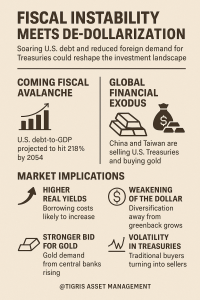
According to the Committee for a Responsible Federal Budget (CRFB), if the Trump administration’s new spending proposals become permanent, U.S. debt will rise by $55 trillion by 2054. That would bring the debt-to-GDP ratio to 218%, nearly double Japan’s — an economy known for its stagnation and yield suppression.
And yet, ballooning debt isn’t the only alarm bell ringing.
Behind the scenes, a more insidious shift is taking place. Foreign buyers are backing away from the U.S. dollar. Not just adversaries — but allies too. And gold? It’s becoming the new global insurance policy.
America’s Fiscal Path Is Unsustainable — And the World Knows It
Under current law, the U.S. debt is already on track to rise by $15 trillion, pushing the debt-to-GDP ratio to 172% even without additional spending bills. This trajectory reflects years of entitlement expansion, deficit spending, and interest compounding under structurally higher rates.
But the return of Trump-era fiscal policy — combining military rearmament, and tariff-fueled industrial subsidies — has supercharged the trajectory. The war in the Middle East only adds to the burden, potentially dragging the U.S. into a prolonged overseas commitment.
This level of debt is not theoretical. It has real consequences:
-
Crowded-out investment in public infrastructure and innovation
-
Weakened U.S. defense flexibility in future crises
-
Federal Reserve distortion via permanent balance sheet expansion
-
Capital flight from Treasuries, pushing up yields and volatility
The world is watching this unfold — and taking steps to protect itself.
China and Taiwan Are Leading the Great Exit
China has reduced the share of U.S. Treasuries in its reserves from 37% to just 22%. At the same time, it has doubled its gold reserves since 2022, with official gold holdings now at a record 6.8% of total reserves.
This isn’t speculation — it’s strategic repositioning.
China is hedging against a future where the U.S. dollar no longer holds unquestioned dominance. By accumulating non-sovereign assets like gold, Beijing is distancing itself from American fiscal and geopolitical risk.
Even more telling is the behavior of Taiwanese institutional investors. Despite close political and economic ties to the U.S., they are now selling Treasuries at the fastest pace since the COVID-19 panic of 2020. If Taiwan is repositioning — amid rising China threats and under the U.S. defense umbrella — the signal is clear: trust in U.S. financial stewardship is eroding, even among allies.
The Dollar’s Dominance Is Being Eroded, One Ton of Gold at a Time
What makes this moment different from past debt scares is that it’s not just a theoretical risk. It’s showing up in portfolios.
Central banks are:
-
Diversifying away from Treasuries
-
Rebalancing into gold
-
Preparing for a multipolar reserve regime
Gold is not a nostalgic asset anymore — it’s a geopolitical hedge. It’s liquid, non-sovereign, and immune to sanctions. And in a world where fiscal sanity is in short supply, gold has become the only neutral ground.
Market Implications: A New Global Investment Thesis
This is not just a fiscal debate. It’s a full-blown re-pricing of risk. Here’s what it means for investors:
1. Higher Structural Yields
U.S. bond issuance will surge, but demand is faltering. The government will need to pay up. Long-term rates may settle at higher levels — killing the case for richly valued growth stocks and zombie corporates.
2. Rise of Real Assets and Alternatives
From gold and commodities to private credit and infrastructure, investors will chase tangible value and yield insulation.
3. De-risking the Dollar
Global reserve managers may begin settling more trade in yuan, euros, or commodity-backed contracts, reducing the USD’s network dominance.
4. Volatility Becomes the Norm
Without reliable foreign buyers, Treasuries will face bouts of illiquidity, especially during auctions or military escalations.
5. Flight to New Reserve Models
Expect sovereign wealth funds and institutions to spread allocations across gold, foreign bonds, digital assets, and inflation-linked securities — a move toward multipolar safety.
Final Thought: This Is the Crack in the Global Foundation
Investors still parse Fed statements, inflation prints, and earnings seasons. But the real story is what’s happening beneath the surface.
The Trump administration’s fiscal stance, the Israel–Iran war, and the rise of global gold buying are all symptoms of the same shift: the slow, irreversible erosion of dollar dominance.
The U.S. can no longer assume its debt will be passively absorbed by foreign central banks. Nor can it assume that “flight to safety” will always mean buying Treasuries.
The next shock — whether geopolitical, fiscal, or monetary — may trigger a more visible break. The question is not if de-dollarization is coming. It’s how fast. And whether your portfolio is ready for it.
Read all other blogs
No Comments